ON SELF MOTHERING
by angeliska on May 12, 2018
Looking back now, I can’t remember exactly when or where on my healing journey I became aware of the undeniably unhappy presence of my inner child self. I do, however, remember very clearly the words that first helped that part of me really begin to heal. They were, “Do you have a stuffed animal?” I sat across from my therapist on the couch, squirming uncomfortably, and trying to evade the question. I mean, yes, I had always slept with a stuffed animal, or doll-friend, ever since I was little, and well into adulthood – but after my last cloth-friend, Swinelet (a once blue and pink pig, acquired when I was 17, now tattered, grey and nearly missing an arm and leg) had to finally be retired due to disintegration caused by an excess of love, I felt a little silly about replacing him. I was nearly thirty-six years old, after all, and surely too old to still need something to snuggle in the night. I answered that I still had a matryoshka doll shaped pillow, reminiscent of my original cuddle-buddy, the legendary angel doll, who I remember being sewn together by my aunt Melinda when I was four or five. She too eventually had to be retired, her fabric becoming translucent and beginning to shred. I always have held to a theory that when I was in the womb, I would clutch a bundle of my own umbilical cord for comfort – and ever since then, I have found it difficult to sleep peacefully without a smushy armful of something soft to hold as I drift off to slumberland.
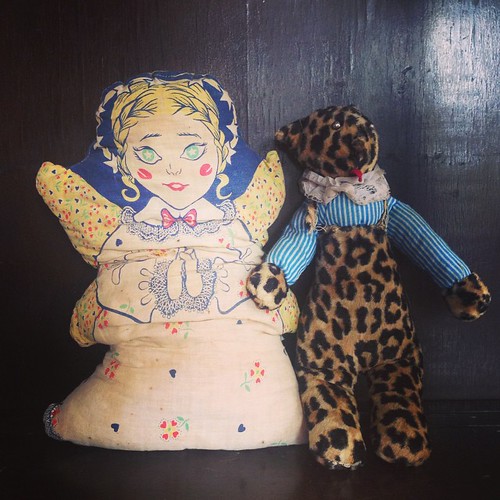
Two of my oldest and dearest friends.
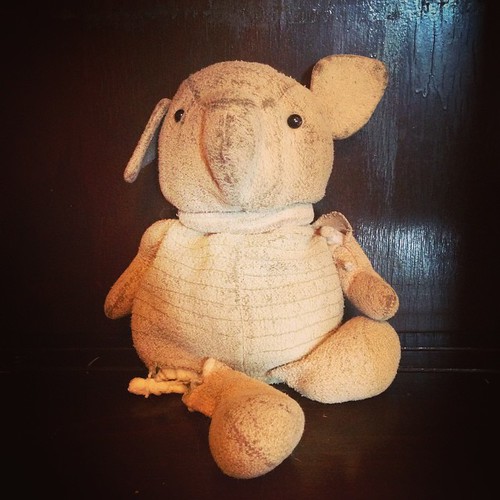
Swinelet is Real. I know, because I loved him to bits.
My therapist wrinkled her brow, contemplating the idea of my matryoshka pillow, and finding it insufficiently personable. It was true – I didn’t think of that pillow as having much of a soul or distinct personality in the way I had always regarded my past stuffed fabric loveys. They were alive, no doubt about it. When I was little, I’d apologize to my stuffed animals if I’d inadvertently neglected them, or if they’d tumbled to the floor in the night. I knew they had feelings, and souls. I couldn’t have explained to you exactly what it was that made them that way, but rendered my Barbies and My Little Ponies soulless, but I knew innately that they were just hunks of plastic that only moved and interacted when I made them do so. My stuffies on the other hand, I always suspected had vibrantly exciting lives and all kinds of adventures they got up to when I was asleep, at school, or just looking in the other direction. I was the kind of kid who sobbed reading The Velveteen Rabbit and The Skin Horse, and I am glad to have become the kind of adult who still does the same. So, when my therapist suggested that I go to the toy store and let my inner child pick out a stuffed animal, I made myself stop squirming, and decided to listen to her. She said, “Let your inner child pick it out. Whatever she wants, go with that. Even if it seems embarrassing or silly-looking to you as an adult.” The heart wants what it wants, right?
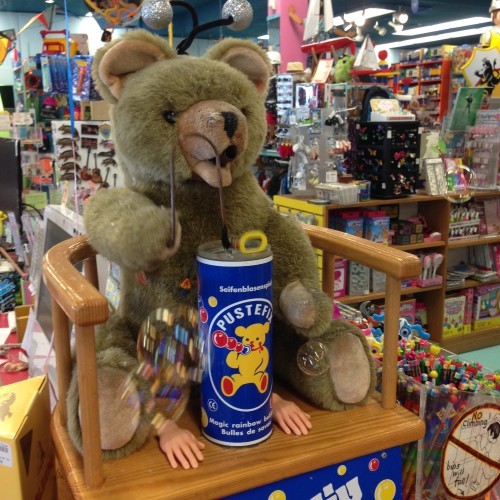
At Terra Toys, there’s a magical teddy bear that blows bubbles!
That’s how I ended up by myself at the toy store, one fine bright day, self-consciously grabbing a basket, aware that I wasn’t there to shop for any nieces or nephews, but instead, solely for myself. I went to Terra Toys, a truly magical wonderland filled with all kinds of treasures for children, and a place I had loved going when I was little. I quietly told the kid part of myself that she could pick out anything she wanted, absolutely anything, and that she could take as long choosing as she needed. I then proceeded to find myself methodically examining every section of the store with great curiosity and delectation, filling my basket with marbles, glitter bracelets, plastic animals, sparklers and candy. I lingered long over the dollhouse area, with its miniature representations of all manner of household objects: tiny braided loaves of bread, and itty bitty porcelain teacups housed within intricate reproductions of Victorian parlors. I had loved looking through the glass cases at these elaborately designed worlds as a child, and found that they had lost none of their ability to captivate me all these years later.
I allowed myself to ask about the finely made (and quite expensive) German Steiff stuffed animals, with their bristly fur and realistic faces, but none of them were soft enough to really snuggle down with. By the time I had made it around to the real stuffed animal area, I could feel the inner child part of me feeling a little braver about being able to ask for what she wanted, and I let her try hugging about damn near every creature they had, from red pandas and blue elephants to giant sloths and even a dragon or two. In the end, I kept coming back to a simple white owl, who felt extremely huggable. Her tag read, “I am Woodland Babe Cream Owl.” My inner child let me know immediately that her name was Owly.
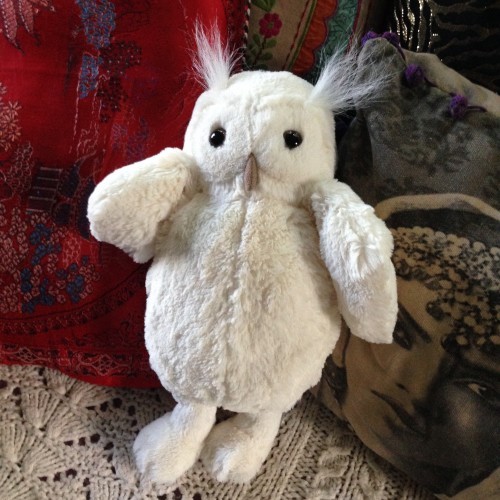
Owly became a big help to me as I started delving deep into healing the wreck of my childhood, with the long illness and subsequent death of my mother, when I was seven, a move to another town and home, and navigating a new life with my grieving, overworked and overwhelmed father. These events and others too numerous to mention here shaped the way I grew, and left me struggling as an adult to overcome unhealthy patterns in relationships that emerged as a result of the developmental trauma and emotional neglect that I experienced. When I really started being able to see the child in me who had remained frozen within for all those years, longing for attention, connection and care, and found a way to treat her with compassion and attentiveness, my understanding of myself and my situation transformed radically. I finally started learning how to tend to those emotional needs myself, instead of enlisting the care-taking of inappropriate lovers or my still overworked and overwhelmed parents. With that dedication, everything began to shift for me. Owly gave me permission to feel small and scared, and my therapist told me to let myself tuck her under my arm when I felt lonely in my house, or hold her when I needed extra support. I slept with her in my arms every night (and still do) and (mostly) unabashedly took her along to dentist appointments when I knew I’d be having a stressful procedure. The dental hygienists never batted an eye.
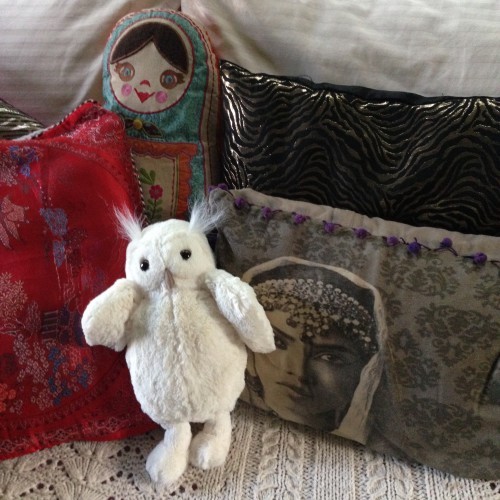
Finding a way to connect with the child part of myself who had gotten so throughly lost in the chaotic mix of my childhood and adolescence taught me so much about who I really was, and all the stories that had been motivating me for years. I was an old souled kid, a serious little bookworm who tended to be fairly stoic about the traumatic changes in my life – until I would eventually reach a breaking point and erupt into hideous tantrums or piques of running away from home. In many ways, by ignoring that aspect of my being, I gave her more power. My inner child had taken over in many areas of my life, and was totally driving the bus – directly towards the kinds of people and patterns in relationships that felt familiar and safe to her (even if they were anything but.)
Recognizing how much she had been suffering alone for so long made me decide to commit to helping her heal, and I started taking baby steps towards making peace with myself. The first step was that trip to the toy store. I could feel that part of myself within feeling a little mystified and curious about what would happen next with all these goodies. Was it time to play with them? Eat all the candy at once? Then what? But before I let myself do any of that, I first found a photograph of myself from when I was maybe six years old, not long before my mom died. I remember the moment that picture was snapped, but I don’t recall who took it. I was sitting on a chair in the living room of our old house, with the soft light from the sliding glass door illuminating my face. I remember whipping my tiny glasses off moments before the photo was snapped, shy about wearing them already. Because the photo is slightly out of focus, it feels in some ways like the whole world was affected by that decision in that moment, by my own defective vision. You’re blurry when I look at you, and so I must be blurry when you look at me. I’m not smiling. My eyes are huge, and my mouth is set and grim. I look like a very sad, scared and lonely little girl, which is what I was. When I look at this picture of myself, I can really see me. I remember being that little person very well. This picture may be the most vulnerable and real photograph of me ever taken.
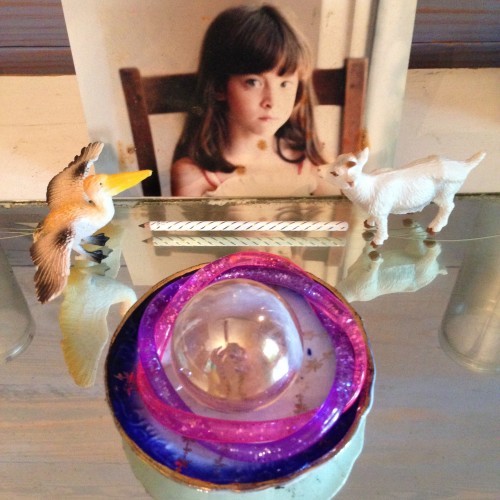
With this image of my child self, and the treats I had let her pick out at the toy store in hand, I set about building a little shrine for healing and honoring the wounded child within. You can do this yourself, if you feel moved to. I recommend finding a photo of yourself (if you can – if not, maybe try drawing one) when you were small, where you can really see your true self. Where you are allowing yourself to be real, for a moment. No fakey school picture day grimaces (unless that’s all you’ve got). Make a little space for yourself. Light some candles. I like using pink ones, for self-love. Make offerings to your child self: maybe little toys and candies, or crystals and flowers, or special rocks you found on the ground. It can be as simple or as extravagant as you feel called to offer to yourself. This is a space to sit with and honor your inner child. To let them know you care, that you’re listening, and paying attention. Ask that part of yourself, “What do you want? What is missing for you? What can I do for you? What would help you most right now?” Keep asking, and keep listening. I find that it’s much harder to be mean, neglectful or dismissive of myself when I look into the eyes of that little girl in the picture. I’ve found that often it’s easier to show gentle loving kindness, unwavering friendliness, and unconditional compassion to that child self, than it is to our adult selves. Show that little kid that you’re looking out for them, that you care deeply for them. See what happens. Do this every day if it feels like it would help. Be gentle with yourself. Be a good mama to little you.
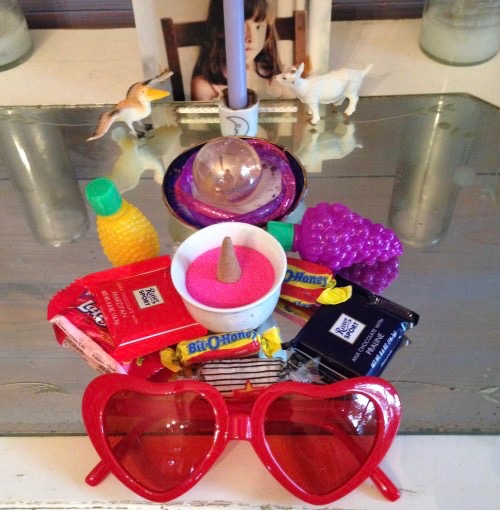
I was called to put this practice in to action a few years ago, when I moved into my brand new bedroom. I’d been in the same room for ten years, and had recently created a shining new space for myself, a haven for rest and rejuvenation. As the room moving date got closer and closer, I had friends asking me if I was excited about my new space. I was indeed – but I was noticing something else… A creeping sensation of anxiety and trepidation that made absolutely no sense, given the circumstances. After all – every single thing about this shift was positive, and it was all self initiated and self created. No one was forcing me into making this change!
When I checked in with the part of me that was experiencing fear and really listened, I realized that it was my child self who was feeling so freaked out – and that for her, even good changes could be really scary. That part of me was used to clinging to the familiar, even it if had grown stagnant and unhealthy. I felt a temptation to scoff at myself for being uneasy – to call myself a big baby, and tell myself to suck it up, get over it, and be happy, goddamnit! But, I’d learned from countless past experiences that this method was pretty ineffective when it came to confronting and comforting my inner child. She required another approach.
So – I asked her what she needed, what would help her feel more peaceful. She didn’t know! She was upset and ashamed for feeling scared when she knew she should be happy. I sat quietly with that part of myself for a bit, and checked in with what I was really afraid of. Unfamiliarity, leaving behind the good parts of the past and never seeing them again, bogey men, the dark. I let that part of myself know that it made sense for her to be afraid of these things, and that it was okay. I suggested doing a blessing ritual before bed, that first night in my new room, and leaving a circle of candles (safely, sitting in bowls of water!) burning while I slept. I perceived an internal non-committal shrug, but a willingness to try it out. I chased out all the bogey men, and sanctified my new space to be a sacred sanctuary that would only allow in good energy.
That night, I curled up to sleep with all the candles glimmering, and Owly in my arms – and in the morning woke to find my inner child looking around in wonderment and delight at the space I’d created for her. It was as if she was skipping around the room, exclaiming, “I love it here! It feels so good!” I’d designed my dream bedroom to be an updated grown up version of the beautiful childhood bedroom my mother had created for me – which was one of the clearest displays of love and affection she gave to me as a child, with periwinkle blue walls, and crystals in the windows making rainbows. Having to leave that bedroom when she died was heartbreaking, as was everything about my life at that time. I had never had such a pretty space to sleep in since then, until I chose to give that gift back to myself. I know very clearly that if I had chosen to ignore that distressed child part of myself and not tended to her lovingly, that the uneasy feeling could have gone on indefinitely. And, looking back – it really didn’t take an enormous amount of effort to shift it. Just a little love, and a little listening.
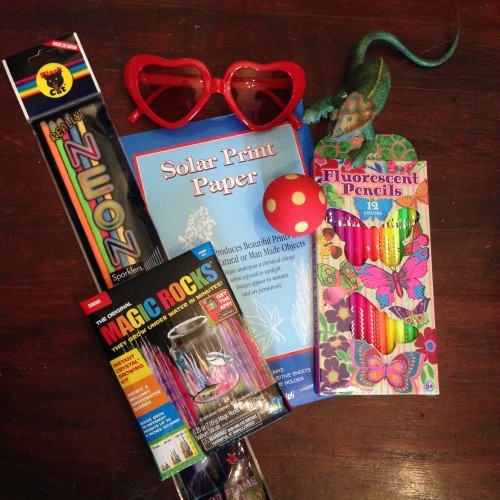
Goodies my child self chose at the toy store: neon sparklers, magic rocks, solar print paper, heart shaped sunglasses, fluorescent colored pencils, a mushroom eraser/pencil sharpener, and a chameleon.
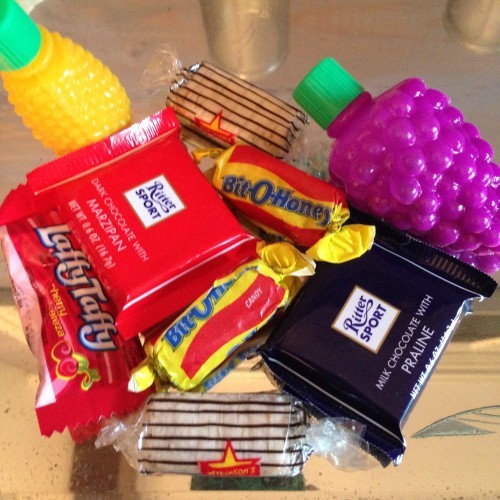
I didn’t even end up eating most of these nostalgic candies myself (because whoa, sugar!) but my child self was delighted to receive them as offerings.
There are so many ways to lovingly reparent yourself. Regardless of gender, or gender expression, anyone can offer the unconditional love and nurturing support of mothering to one’s self. Doing this doesn’t take away from what your own mother (biological, adopted or stepmama) was able to give to you. Giving yourself love doesn’t mean that she didn’t do a good job. She did the best she could with the resources she had or didn’t have. She might have given you everything she had, and you might still find that you need more. That is okay. Give it to yourself. You can do this – you are allowed.
Sometimes you have to imagine that inner child, seeing them clearly in your mind’s eye, and picture opening up your arms to them – putting them on your lap and enfolding them, saying “I love you. I am here for you. I will protect you, and I will never, ever leave you.” You have to convince that part of yourself that this is true, through consistent daily offerings of compassion. This can look like making sure you brush and floss your teeth and wash your face, or taking a nice bath and putting on your pajamas and curling up in bed with a book (and your stuffed animal!). Sometimes a big part of self-mothering is taking the kid part of us out of the driver’s seat, and strapping them into the carseat instead. They’re just babies, so they’re not allowed to drive the car – particularly not towards people and relationships who will confirm our old and familiar patterns of neglect or abuse. The loving mother part of ourselves is able to say, “No, no, no” and redirect the inner child from running straight towards the fire, or playing in the muddy puddle of unhealthy or dangerous relationships.
A big part of self-mothering for me involves the care and feeding of my inner child. I never really hung out with my parents when they were preparing meals, and consequently never learned much about how to cook for myself. Dinner times in my house growing up were more about getting something in our bellies fast, rather than teachable moments with the whole family pitching in. So making sure I eat nourishing food instead of junk or just carrots and hummus or something for dinner is a big part of that mothering that I do for myself. When I first started doing this, my child self begged for kid food – pudding and pop tarts and treats. I compromised by getting myself the healthier, hippie versions of these foods when possible, and after a while of indulging that part of myself, she stopped asking for that so much. In fact, what I’ve noticed after participating in this practice, and engaging a whole lot of other modes of healing for my childhood trauma, was that the wounded, scared child part of myself calmed down, and integrated more deeply into the rest of me. When I first realized she was there, she was kind of hiding – cowering in the corner of my soul, shaking and crying. Now, when I check in on her, she’s quietly coloring pictures or looking around at stuff contentedly. She’s a part of me that doesn’t feel as separate and isolated anymore.
‘’The fact is that the majority of so-called adults are not truly adults at all. We all get older. Anyone, with a little luck, can do that. But, psychologically speaking, this is not adulthood. True adulthood hinges on acknowledging, accepting, and taking responsibility for loving and parenting one’s own inner child. For most adults, this never happens. Instead, their inner child has been denied, neglected, disparaged, abandoned or rejected. We are told by society to “grow up,” putting childish things aside. To become adults, we’ve been taught that our inner child – representing our child-like capacity for innocence, wonder, awe, joy, sensitivity and playfulness – must be stifled, quarantined or even killed. The inner child comprises and potentiates these positive qualities. But it also holds our accumulated childhood hurts, traumas, fears and angers. “Grown-ups” are convinced they have successfully outgrown, jettisoned, and left this child – and its emotional baggage – long behind. But this is far from the truth.” – Stephen A. Diamond Ph.D.
We have a lot of different parts of ourselves, different aspects of our souls, our beings, our psyches. When I talk about having an inner child, it’s not like having multiple personalities (though I suppose it could sound that way) – the inner child part of ourselves is what stays stuck, or often gets frozen at the age when our childhoods went seriously awry, and our essential needs were not being met. We may have been raised in households where we were fed, clothed, and had a roof over our heads, but we did not feel seen, safe, soothed and secure. Those four S’s and whether we did or didn’t receive them consistently have so much to do with our ability to self-regulate our emotions, reactions and responses as adults. So how can we help ourselves feel seen, safe, soothed and secure?
Feeling truly seen and heard is a big part of my wounding, as I was the only child of a very sick and depressed mother who was extremely preoccupied and more often than not, left me to my own devices. Daily journaling helps me check in with myself, patiently listening and recording my innermost thoughts, feelings, dreams, fears and musings. There are times when I find myself wanting to skip ahead or gloss over what I really want to say – where I get impatient with myself like people often do with children for telling interminably long, rambling (and seemingly pointless) stories. But I’ve found that when I’m willing to stop and say to myself, “Hey, I want to know more about that. Please tell me.” I give myself permission to write about whatever’s in my heart and mind instead of feeling like I should only write what’s really “interesting”, or particularly insightful. It’s in those moments that I allow myself to be seen and heard, for myself, by myself.
Another way to practice self-mothering is to use the kind, compassionate voice of the inner mother to combat the harsh, needling messages from our inner critic. I learned this lesson one lazy morning when I was cooking scrambled eggs, jamming out to the radio in my underwear. Suddenly I got a text message that informed me that I was supposed to be somewhere else at that moment – in fact, I was supposed to be dressed in elaborate full costume and telling fortunes at an event about thirty minutes prior. I had screwed up the times, and thought I had hours until I needed to be getting ready! In a heated flurry of panic, I hustled myself together, got into the car, and started racing to the venue.
My heart was pounding, I was sweating profusely, and I became aware that I’d been listening to an internal monologue from my harsh inner critic ever since the moment I received that text, which was informing me in no uncertain terms that I was irresponsible, a failure, a total fuck-up, that no one would ever want to hire me again, that I had ruined a perfectly good opportunity, asking how could I be such an idiot? Oh man – it was awful! The more I listened to that internal tirade, the worse I felt, and I instinctively knew that if I kept that up all the way to the gig, I’d be even more of a wreck by the time I arrived, and maybe not even able to do my job well. So I made I conscious decision to switch the radio station in my mind to the loving mama channel. This voice was much gentler, saying “Hey honey, try to calm down, okay? Breathe. So, you messed up. That’s okay. Everybody messes up sometimes, and today it’s just your turn. All you can do is do the best you can, take responsibility, and try to make up for it. You are still lovable, you are still valuable. You matter. It’s going to be okay.”
Whew! What a difference that made! By choosing to talk to myself in a more loving way, I was able to calm my racing heart, and be ready to spring into action and (relative) professionalism by the time I arrived at the event. I did a good job, and it all turned out well in the end. I still think of that day during times when I’m being unnecessarily cruel to myself. Listening to that mean inner critic never helps – it never, ever makes things better. Now that I know how to access that sweet and compassionate inner mother within me, I can choose to listen to her voice instead – which always, always helps me feel calmer, more centered, more trusting, more loved. You can do this for yourself too. It takes some practice, some awareness, some dedication, but I recommend starting with even the tiniest of baby steps towards self-compassion. Even those can make such an enormous difference.
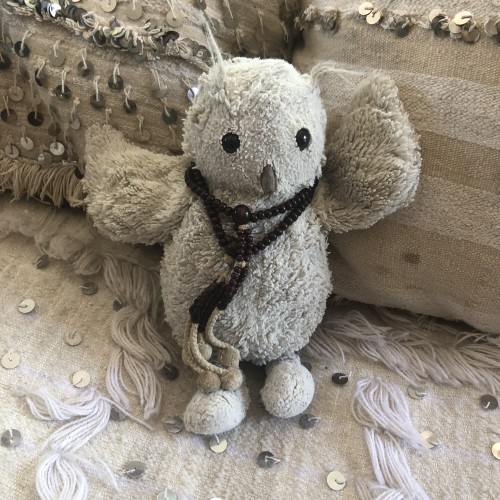 Owly these days…
SONGSPELL #1 – Sing a loving lullaby to little you. “You Were Born to Be Loved” by Lucinda Williams is a real good one – and that little me really needs to be reminded of sometimes. It doesn’t matter if you “can’t sing”. We can all sing. It doesn’t have to be “good” – just heartfelt. I’m singing this with raspy nodules on my vocal cords (when I’m actually not supposed to be singing at all) & traffic going by & my dogs barking & this is the first time I’ve ever recorded myself singing & shared it ever. Why? Because I believe in the healing power of radical vulnerability & the power of songspells. So, more to come. You can try it too! Let me know if you do! I love you. You were born to be loved.
You weren’t born to be abandoned
You weren’t born to be forsaken
You were born to be loved
You were born to be loved
You weren’t born to be mistreated
And you weren’t born to misguided
You were born to be loved
You were born to be loved
You weren’t born to be a slave
You weren’t born to be disgraced
You were born to be loved
Mmm hmm, you were born to be loved
You weren’t born to be abused
You weren’t born to lose
You were born to be loved
You were born to be loved
You weren’t born to suffer
And you weren’t born for nothing
You were born to be loved
Mmm hmm, you were born to be loved
“Your origin story doesn’t get to change; your childhood was what it was. But your story is still being written. As we gear up for Mother’s Day please remember that regardless of your gender, it’s your job to Mother yourself through this life. May you be a kind, warm, strong, reliable, and loving Mother to yourself today and always.”
– JESSICA LANYADOO
Here are more of my writings on the subject of mothering, being unmothered, and Mother’s Day:
☾ MATRESCENCE
☾ FLEDGLING HEART
☾ MOTHER’S DAY
IMBOLC – Brighid’s Blessing
by angeliska on February 1, 2018
Every year on Imbolc, I honor the sacred wheel’s turning by doing some ritual spring cleaning: I like to clear out my tarot trailer, tidy my house, wipe down my hearth and altars with sweet oils. I sweep the cobwebs from the nooks and crannies, dust the bottles of herbs, resins and powders, and process the accrued bits of magical flotsam and jetsam that always seem to pile up on every surface. I make a bonfire for Brigid, and let many things go into it: old wishes, dead spells, and bits of witchery that have served their purpose, and are ready to become ash and air.
Imbolc marks the quickening, the first hints of turning from the old season into the new – the very moment when the first hints of spring seem finally possible. Imbolc means “in the belly”, something quietly growing, maybe not quite showing, but every day building strength, getting ready to emerge in the physical world. This is the time of new lambs, of new life, reclaiming eros energy from the dead world, the frozen barrenness of deathly winter. The buds have not yet appeared on the bare branches, and the world has not yet turned florid with bright blossoms, and yet, here and there, if you look closely, you might detect the first signs that the maiden is returning from the underworld.
Tiny succulents are peeping out from the soil in their planter on my porch, and yesterday, a little wood violet bloomed, the sole flower in my garden, for now. In the velvety soft gray mornings, I wake to the excited gossiping of the songbirds, who have been returning to the leafless sycamores in my backyard. I hear them talking amongst themselves about the return of springtime, about warmer days, and balmy evenings, about the eventual re-emergence of the fireflies, and caterpillars, about the tender buds and berries, the fresh new shoots, bright green tendrils emerging, sweet sap rising. The hag of winter’s face is slowly turning, back behind her tattered veil, her white shawl of snow, to reveal the strong young face of the maiden, of Brighid. The Cailleach returns to her home under the hills, and is reborn anew, as a bright and warm goddess, Breo-saighit, fiery elf arrow, a sacred well, a red fox, a meadow of snow-drops. The wind is in the trees, and spring comes!

Light all your candles, tend your hearth-fires. Leave pieces of cloth outside for Brigid to bless as she passes by, and these will protect your throat from unwellness.
My mother named me for Brighid, consecrated me to her before I was born. I have always been her daughter. My name was meant to be Bridget Angela, but at the last minute, after I had emerged and my birth certificate was being made, my mother frantically yelled out from her weak and wounded post-natal swoon that it needed to be switched, that my name was Angela Bridget. Her vehemence got the nurse’s attention, and here I am – though I’ve never really gone by Angela, and I never liked the name Bridget for years either. I thought it was too cutesy, bringing up images of a red-haired girl with a bob and curls, a freckled button nose, and a cheerful attitude. I had none of those things. Bridget the midget, Gidget who fidgets. I wasn’t into it. I didn’t yet know who the real Bridget was, or that I belonged to her.
As a young girl, I wanted to be Brigitte instead, also not yet knowing about Maman Brigitte, Baron Samedi’s wife, the loa of the cemeteries. I grew up in graveyards, always around so much death – and I found comfort in the company of the dead. There is so much that I didn’t understand as a child, with no one I felt I could talk to about these things. Young witches can be formidable, livewires of power they don’t know how to wield. I was changing the weather, bringing the thunderstorms at will – and was both terrified and elated at what I was capable of. When I realized last year that Oya, orisha of hurricanes, storms and sacred change was syncretized with Maman Brigitte in Vodou, and St. Bridget, it hit me with the force of massive typhoon that my relationship with this power, with this goddess, began long before I was born. It wasn’t something that I discovered. It just always was – waiting for me, somewhat patiently, until I remembered. When I see the synchronicities lining up, it shows me that I’m on the right path – and they have been there for me all along, those shining breadcrumbs, beckoning me to follow, to keep walking forward, deeper into her mysteries.
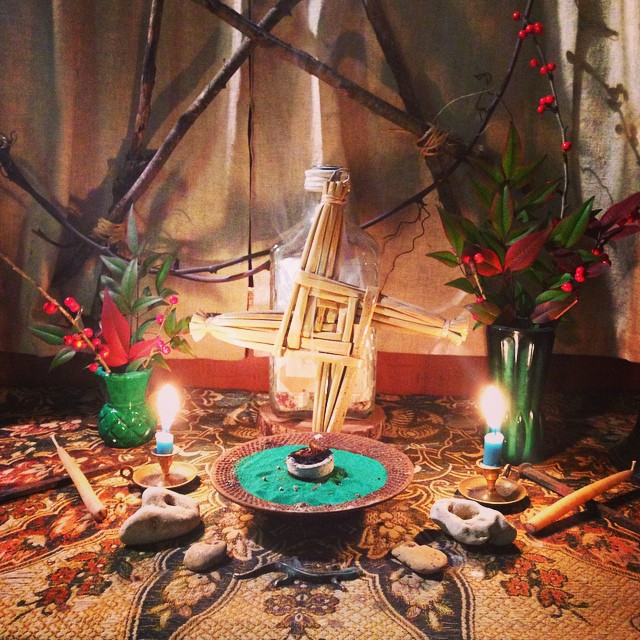
Bright Imbolc altar. Come in, Brighid! Come in, spring! Come in, light! Be welcome, fierce maiden! Welcome Brighid, keeper of the fire, forge, hearth and heart.
Goddesses are real. Not just in history books, or as ancient myths, or archetypes, beautiful images, sculptures carved in stone and worshipped long ago, but as real as you and I, and in fact, within us all. It seems so obvious to say it, but part of me didn’t really truly understand that until fairly recently. I appreciated the idea of the Goddess as an abstract, as an idea or a concept, rather than as a concrete reality, a truth I know and feel in my bones every day. They are with us, guiding our movements, our lives.
This knowledge has inspired me to dedicate my life to serving the goddess, to honoring her, in her various forms – not as a given, or in theory, but in practice, as a devoted disciple, as priestess, as daughter. When the Goddess calls to you, you must heed her. I realize now that I belong to certain goddess-forms, and always have. The Goddess Brighid is one of them – healer woman, fire spirit, who guides the hands of the poets, the blacksmith and silversmiths, shepherdess, rainbow mantled, dew-laden, fairy woman. She has many names, and many faces:
“Brighid-Muirghin-no-tuinne, Brighid-Conception-of-the-Waves;
Brighid-Sluagh (or Sloigh), Brighid of the Immortal Host;
Brighid-nan-Sitheachseang, Bridget of the Slim Fairy Folk;
Brighid-Binne-Bheul-thuchdnan-trusganan-naine,
Song-sweet (lit. melodious mouth’d)
Brighid of the Tribe of the Green Mantles.
She is also called Brighid of the Harp,
Brighid of the Sorrowful,
Brighid of Prophecy,
Brighid of Pure Love,
St. Bríde of the Isles,
Bríde of Joy,
and other names.”
– from Fiona MacLeod (aka. William Sharp) in his book “Winged Destiny”
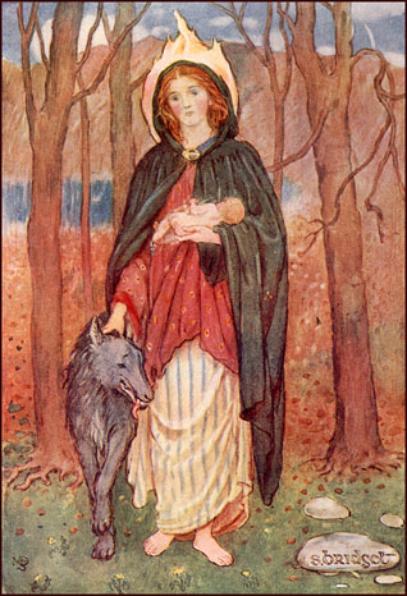
Brighid of the Mantle, encompass us,
Lady of the Lambs, protect us,
Keeper of the Hearth, kindle us.
Beneath your mantle, gather us,
And restore us to memory.
Mother of our mothers,
Foremothers strong,
Guide our hands in yours,
Remind us how
To kindle the hearth,
To keep it bright,
To preserve the flame.
Your hands upon ours,
Our hands within yours,
To kindle the light,
Both day and night.
The Mantle of Brighid about us,
The Memory of Brighid within us,
The Protection of Brighid keeping us
From harm, from ignorance,
from heartlessness,
This day and night,
From dawn till dark,
From dark till dawn.
– Blessing for Hearth-Keepers
by Caitlin Matthews
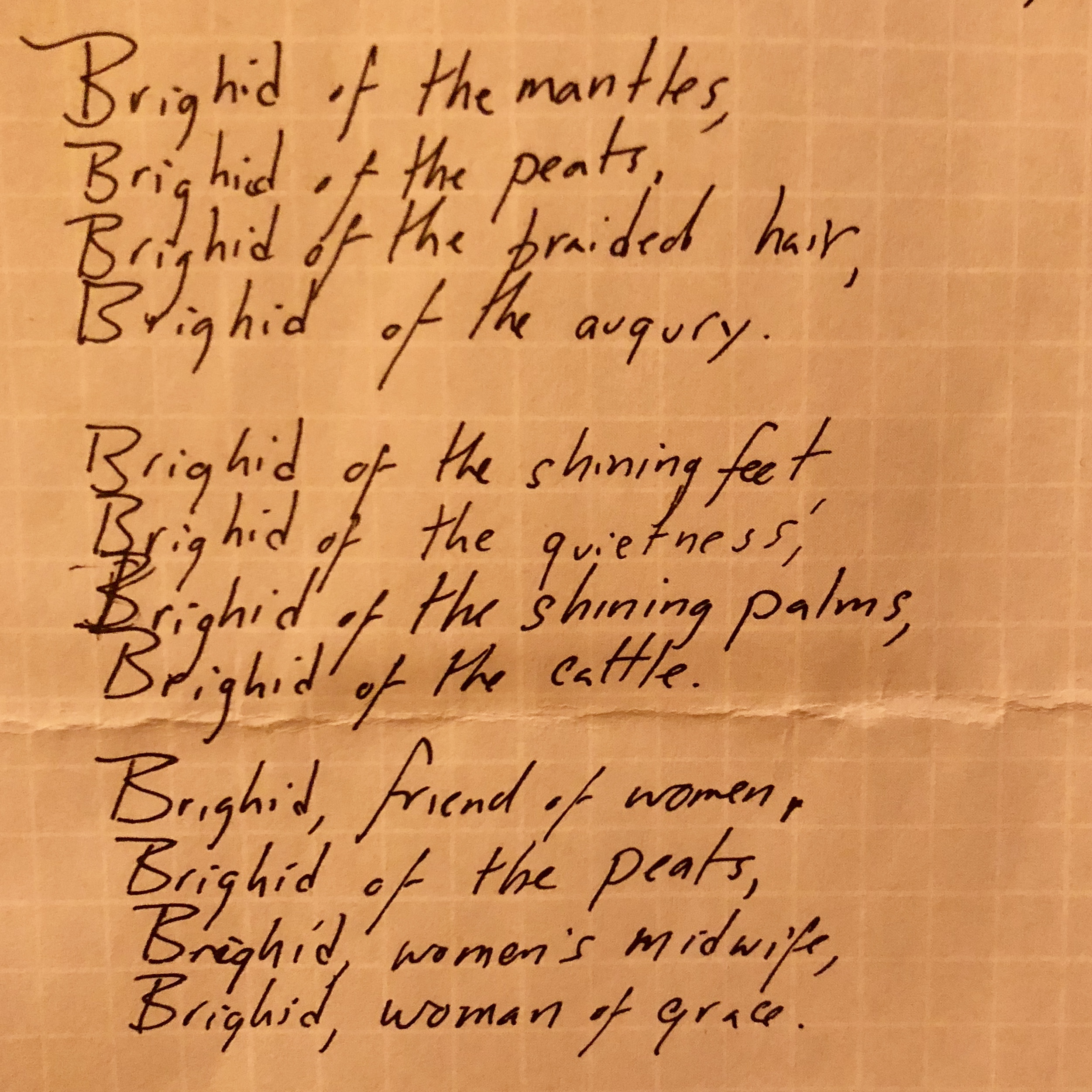
Brighid of the mantles,
Brighid of the peats,
Brighid of the braided hair,
Brighid of the augury.
Brighid of the shining feet,
Brighid of the quietness,
Brighid of the shining palms,
Brighid of the cattle.
Brighid friend of women,
Brighid of the peats,
Brighid women’s midwife,
Brighid, woman of grace.
– an excerpt from Brighid of the Mantles,
Sloinntea rachd Na Brighid, translated by Caitlin Matthews,
transcribed by Brenda Francis
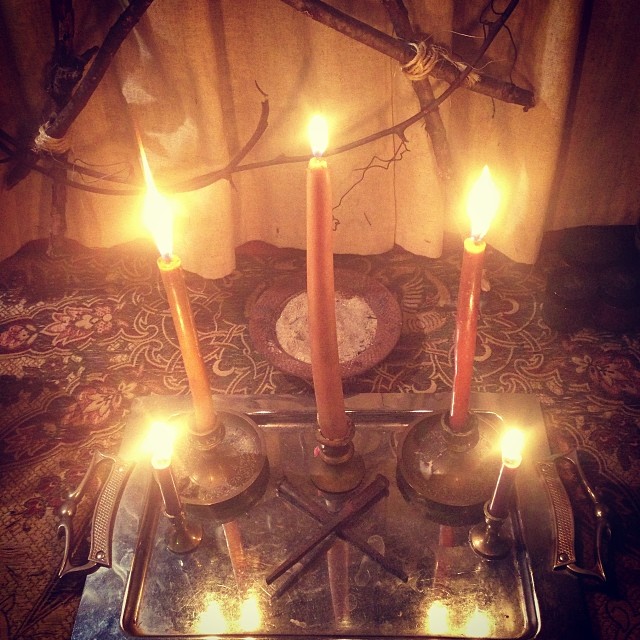
Mar a chaireadh Muire,
Caim Bhride’s Mhuire,
Car an tula’s car an lair,
‘S car an ardraich uile.
As Mary would build it.
The encompassment of Bride and of Mary,
Guarding the hearth, guarding the floor,
Guarding the household all.
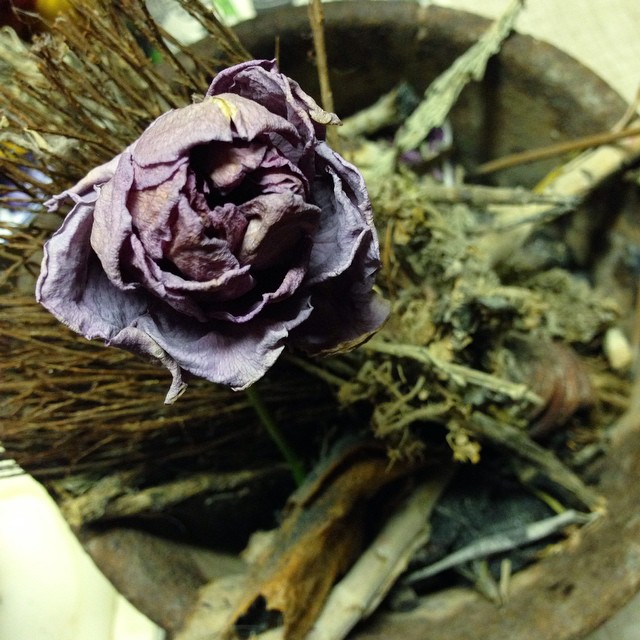
Out with the old, in with the new! Even withered blooms still have their corpsey beauty. Soon to be ashes of roses in Imbolc bonfires.
I wrote this last year, as I was walking through a deep dark time of loss and hurt, that transformed me utterly. Now that I’m on the other side of it, I can see undeniably how necessary those changes were, and how much stronger and more whole I am today, after it all.
I lit a bonfire for Imbolc.
I made my invocations to Brighid,
made offerings to her of aged honey mead.
I burnt my finger on a hot coal,
the sizzle of singed flesh and bubbling copal.
I cut my other finger to the quick
on a jagged piece of cavern stalagmite,
the hidden crystals inside glittering, painted red.
Blood offerings, life-force, soul-water.
I sacrificed two sacred paper deer to the flames,
one a leaping doe shadow puppet Pandora made,
that danced on a bedsheet screen in my backyard.
The other, a handmade papier mache doe piñata
made for me by Francesca and Annie
to celebrate my thirtieth birthday.
They stuffed the deer with frankincense and myrrh,
golden holy virgin medals, fine chocolates,
flowers of Jericho, little girl barrettes,
and other treasures I can no longer remember.
They wanted me to burn it that night, but it was
so beautiful, with a plaintive expression painted in tempera,
that I had to let it live for eight more years, a hollow effigy,
crumpled in the corner of the defunct shower, waiting.
Ghosts of sisters’ love, memories, circles broken and unbroken.
I am burning holy mite-eaten macaw feathers and prayers
for my loved ones, for all of the people who come to me
for tarot reading and healing, for myself, that I may continue to.
I am burning several smudges of cedar and sage and so many memories.
I am burning clumps of old wax and a huge bundle of lavender.
I am burning pieces of wood from the building of my house
cut and stacked and left behind by my last, past love.
I am burning three plum colored candles
for the fates in a deer antler candelabra.
It is winter now, but this is the day I mark to
trust that spring is coming, that the sap will rise.
It is cold and grey, and the sunlight is a pallid gold,
uncertain and watery, but the fire warms me.
I feel fierce and determined and deep down sad.
I feel like a warrior woman exhausted after battle
sitting on a bloody treestump to unhook her armor.
I feel a fire burning at my core,
a root fire that tells me I will survive,
and that my deep down anger will eventually
give way to passion.
I feel certain that
if anyone walked through my gate right now,
I would fuck them to death.
So my gate is locked with iron.
Iron nails crossed.
Bright blood berries,
the cedar waxwings get drunk on them
when they ferment in the spring.
I make my solitary prayers
and ask for her help in this,
that I may come through wiser,
so that I may better serve her.
I am bold, and I am braver.
My bones are tired,
but I’ll get stronger.
It is Imbolc,
and I am burning.
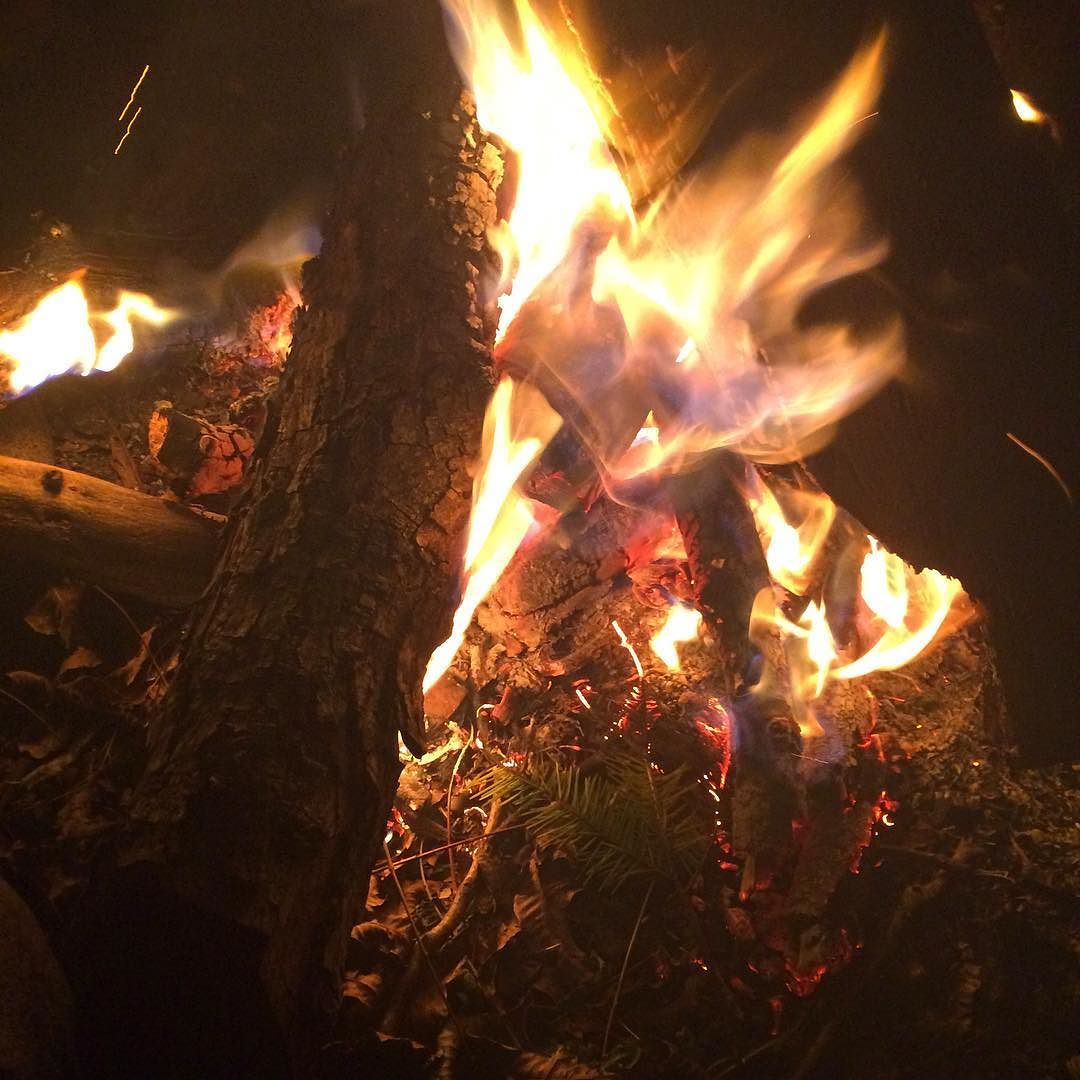
This was my first fire of the New Year, for a full moon ritual with four solid corners holding it down and raising it up. This was so necessary for me – to be in nature, with the elements called in, gazing into the embers, drawing down the moon with strong witches. To honor the holy days.
“The original meaning of the word holy is “set apart”. In holy day time/space, we surrender our engagement with the outer world, go to be restored and renewed. In all cultures, to enter the tenemos (enclosed sacred space) is to be released from chronological time, to enter the timeless realm of the sacred. In ritual and ceremony, we and the world are healed and strengthened.”
– Sherri Rose-Walker
I have been feeling like a big mammajamma bear that just wants to go hide in her dream lodge cave and sleep until springtime. I keep reminding myself that it will be spring here soon enough, and feeling so grateful that I live in a climate where our current version of winter is considered somewhat extreme. For a winterborn being, I get worse and worse at enduring the winter season and better and better at enjoying the summertime every year. Perhaps I’ll like it better when I can invest in proper heating for my home. Dinky inefficient space heaters are the pits! Still, I’m grateful to have them, too – and don’t have to chop my wood or huddle around a cookfire.
God/dess is nature. Lifeforce energy and deathforce energy are a constant circle – a loop of becoming and unbecoming. We are all interconnected. Don’t forget your own divinity and place in all of this: you are every bit as sacred as the crane swooping over the water, as the droplet of water sliding off their wing, as the mite tickling their underfeathers, as the wee beetle sliding off the leaf. You are the seed slipping from the pinecone, you are the ripening berry, you are the rotting log, you are the moss and the fungus – and you are GLORIOUS! Life is a precious gift, and so is death. What a thing it is to be incarnate! I used to not think so. I am glad I remembered.
Spring in the Belly of Winter – IMBOLC: A CROSS-QUARTER STATION OF THE SUN
from Blue Moon Astrology – I love this post from Elaine Kalantarian about Imbolc, Brighid and the astrology and history of this holiday. Very informative, if you’d like to know more!
Brighid’s Blessings upon your hearth and heart,
and a merry Imbolc to you all!
A Rosy Full Wolf Moon Unfurls: Year of the Earth Dog
by angeliska on January 1, 2018
It’s the dawn of a New Year in a few hours, and instead of loading up the caravan and heading for the hills like I normally do on this day, I’m curled up in front of a space heater in my living room, sifting through the last grains of sand that made up 2017, as it slips through the glass.
An arctic cold front is currently blowing down through Texas, making the idea of honoring our tradition of camping out in Lone Grove for New Years somewhat untenable, hardy as we usually are. It’s strange to shift a pattern, to do something differently – to trust that it’s okay to go with the flow, and work with what is. This year, I’m getting a little bit better at letting things go, at holding loosely to the reins of control instead of gripping tight, at moving like water with the current instead of beating myself against the rocks.
So, instead of pushing myself into the wind and cold, I’m hunkered down, writing, and trying to be gentle with myself. Maybe it’s this full Wolf Moon in Cancer rising, or the closing of the year, but I’m grateful that the weather has conspired to let me be easy with myself, because I feel a little shaky, a strange anxiety under what has mostly been a blanket of deep peace. I’m sitting with it, letting it be – observing where the roots lead, and breathing into the fearful places. My neighbors were setting off fireworks last night, enormous explosions that had my dogs on edge. I feel extra sensitive lately, picking up on outside energy, especially the distress of beings I feel very connected to.
One of the big things that happened for me this year, was the addition of a third dog into our pack, which has been a wild experience – especially considering that I was never a dog person until the past ten years or so. Prior to that, I would have always described myself as a cat person, and if you had told me then that one day I would not only have a dog, but three large dogs, I would have thought you were full of poppycock. I never would have imagined that having three dogs would feel like the just the right amount of canine companionship. It’s definitely hard to get lonely when surrounded by this much unconditional love and affection, and – I learn so much from these creatures every day. They are my teachers.
So, I’m thrilled that 2018 will be the Year of the Dog, and an Earth Dog to boot. That energy feels healing and balancing after the past few Fire years, which were so turbulent and intense, especially considering they were ruled by Monkey and Rooster. Being an earth sign myself, and a dog spirit, it feels like a relief to have some grounding, solid energy for this coming year. While the Lunar new year doesn’t really roll in until the second new moon after the Winter Solstice, I like to welcome in this new energy early, at the turning of the Gregorian calendar, and make a space for its wisdom in my life.
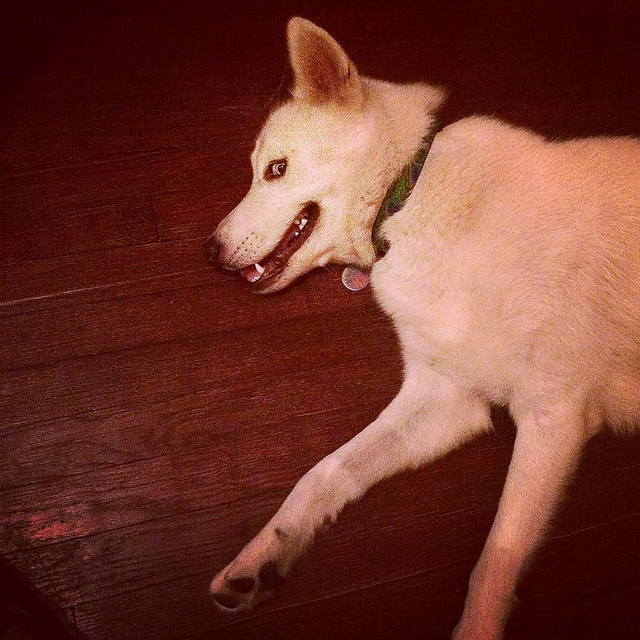
My wild sweet Snow Pea. From the first moment I saw this dog in a dream, I knew we were meant to help and teach each other. The saga of how he came to be my dog is long and involved, but last year, all I wanted for Christmas and my birthday was Snowy. I would lay awake and worry about him, and wish on the moon and stars that he could come live with me. And one day, he did. I look at him all the time in wonder and think about how my heart’s wish was granted, and how amazing it is that this magical creature is my dog.
Earth Dogs are true and loyal, honest to a fault, and teach us to cultivate personal integrity in our character, in our words, and our actions. This is a time to show up, with both feet wildly one the ground. Your presence is everything. This is an action year, where having real skin in the game and making things happen will count so much more than just dreaming or empty talk.
Saturn going into Capricorn will help us get serious about what will actually be required of us to really manifest what we say we want. It’s time to fight for the rights of the underdogs, sniff out corruption, and shine a light on the truth. I feel that dogs are the best teachers of what true friendship means – that steady, abiding light of simple, uncomplicated love that shines from their bright eyes, and is felt in the snuffle of a wet nose, and the brush of a wagging tail. I want to love like my dogs do, to have their lust for life, to stay in the moment as they do, seemingly releasing their troubles, frustrations, anxieties and angers so much more easily than we humans do.
Two concepts have made themselves more known to me recently, and I want to take this year (and hopefully many more to come) to explore them in greater depth. Both speak to a sense of true friendship, with ourselves, with our loved ones, and with the world. The first is maitri, which I’ve been reading about in a little book of essays by Pema Chodron, called Practicing Peace. Maitri is a sense of “unconditional friendliness towards your perfect and imperfect self”. I’d heard the word maitre before, but I guess I didn’t really know what it meant, because when I read that, my jaw dropped. What a wild idea!
It just really struck me – how overwhelming the concept of unconditional love can seem, for whatever reason. Something about unconditional friendliness just seems more manageable to me. This past year, that’s the feeling towards myself I’ve been striving for – to be friendly with myself, especially when I feel like I’m at my worst. Because that’s when I need it the most. It feels doable in way that “falling deeply in love with myself” doesn’t on some days. I can manage that friendliness, that patience with myself when I’m feeling impatient and acting like a pill, that tolerance for all my many flaws. When I catch a glimpse of myself in the mirror, I try to give myself a friendly gesture, a smile, if it feels natural, or sometimes a playful, silly face – a reminder to not take myself so damn seriously all the time!
I think about the way my dogs behave towards me, even when I’m unwashed, running behind on their breakfasts, grumpy or in a bad mood. Even when I’m like that, they still seem to think I’m the best person in the world. They accept me as I am, and they forgive me for not being perfect. And I feel the same way about them – even when they pee on the floor, chase the cat, escape the yard, or um, bite me. All of those things have happened this week, and honestly, it’s been really trying. But I don’t take any of it as a personal affront, because none of it is about me, or my dogs trying willfully to make my life more stressful. They are beasts expressing their nature, and it’s my job to learn better how to protect them and interact with them in a way that keeps us all well and happy. It feels miraculous to notice how my heart stays open to them completely, even when we’re struggling. They teach me so much about what loving unconditionally (and being loved that way) really means. And they have been such healers for me.
That being said, my wolfpack has really been giving me a run for my money lately, physically, emotionally, mentally, and spiritually – and it’s a lot to manage! I’m working to create better structure for us, and to be a strong pack leader for them. I have three dogs, and three cats! It’s a lot. A lot to take on, & a lot to be responsible for. They give me so much love and joy in return, it’s definitely worth everything I put in energetically, financially and timewise – but some days are easier than others. Today was a tough one.
We’ve had a few kerfuffles & dust-ups the past few days over resource guarding, and I’ve gotten caught in the middle a few times. I’m working hard with a great trainer to be a strong pack leader and help everyone adjust to the new pack dynamic, and it’s very challenging. I have to be so strong, & so consistent – and always vigilant. Every day is different. I’m sharing this, because behind all the adorable animal photos, there’s another side I feel people don’t talk about often: the fact that these are ANIMALS.
They’re not human, even if we dress them in funny clothes and babytalk to them. They are not too far away from being wild beasts, and if you want to have them in your life, you have a real responsibility to understand how they work and make a real dedicated effort to learn and speak their language – rather than expecting them to learn yours. Take the time, spend the money, study up – whatever you have to do: but train your damn dog! Be strong for them, so they’ll feel safe & happy. I’m trying, every day – and my only hope is that I can be half as good as my dogs think I am.
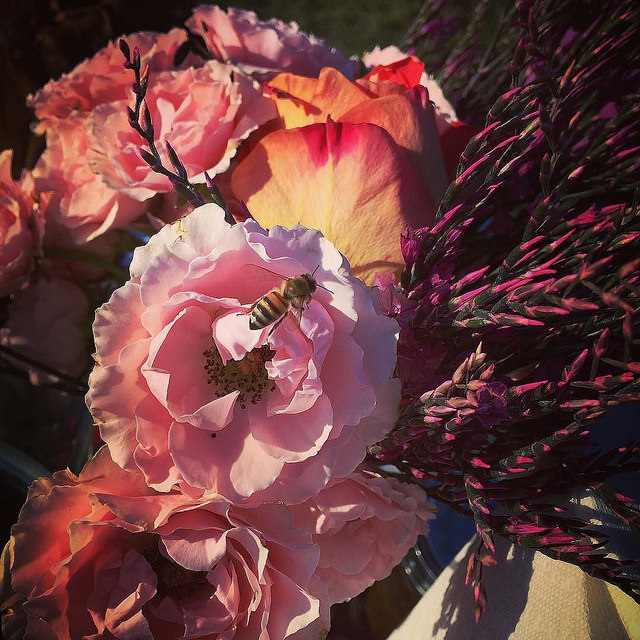
Sonnet XVII
I do not love you as if you were salt-rose, or topaz,
or the arrow of carnations the fire shoots off.
I love you as certain dark things are to be loved,
in secret, between the shadow and the soul.
I love you as the plant that never blooms
but carries in itself the light of hidden flowers;
thanks to your love a certain solid fragrance,
risen from the earth, lives darkly in my body.
I love you without knowing how, or when, or from where.
I love you straightforwardly, without complexities or pride;
so I love you because I know no other way
than this: where I does not exist, nor you,
so close that your hand on my chest is my hand,
so close that your eyes close as I fall asleep.
– Pablo Neruda

Rose medicine is good for when you feel unsure, so remember to put her petals in your tea, or bath. I’ve been carrying big rose quartz orbs in my pockets, and holding them when I sleep.

Our earth altar on New Year’s day of last year
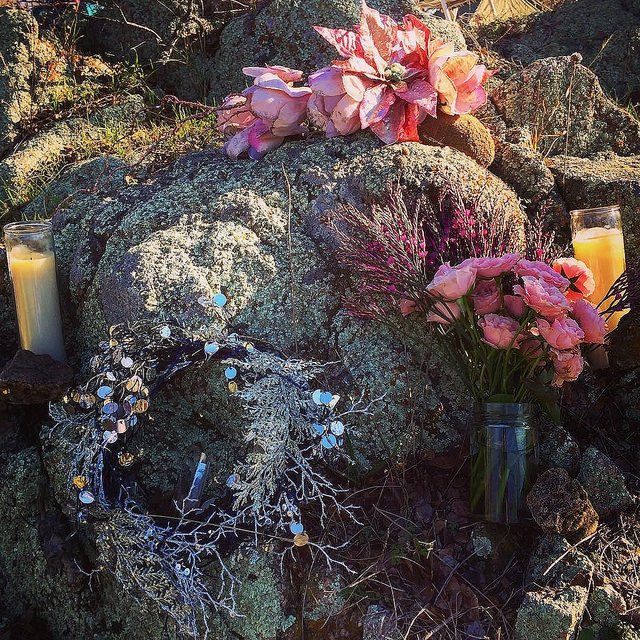
Winter garlands
The other concept I’ve been working with is Anam Cara, which is also the title of the book I’m reading about that very subject, by Irish poet John O’Donohue. Anam Cara means “soul friend” in Gaelic.
“A person to whom you could reveal the hidden intimacies of your life. This friendship was an act of recognition and belonging. When you had an Anam Cara, your friendship cut across all convention and categories. You were joined in an ancient and eternal way with the friend of your soul. You are joined in an ancient and eternal union with humanity that cuts across all barriers of time, convention, philosophy and definition. When you are blessed with an Anam Cara, the Irish believe, you have arrived at that most sacred place: Home.”
– John O’Donohue, from Anam Cara, A Book of Celtic Wisdom
“According to O’Donohue, the Irish term anam cara originates in Irish monasticism, where it was applied to a monk’s teacher, companion, or spiritual guide. Edward C. Sellner traces its origin to the early Desert Fathers and Desert Mothers: ‘This capacity for friendship and ability to read other people’s hearts became the basis of the desert elders’ effectiveness as spiritual guides.’” I think about the work that I do with people, and who I want to be in the world, this path that I am walking, and this word really encapsulates it for me. I want to nurture and cultivate the relationships that feel like this in my life, and in my own heart.
I used to view all my close friendships as chosen family, my brothers and sisters. My concept has shifted in the last few years, somewhat. Those that I considered my spiritual family are still beloved, though time and distance has separated many of us. I also have started wanting to view all beings on earth as my brothers and sisters, and not drawing such a heavy circle of exclusivity around ideas like “us and them”, as I feel that all of our problems come from this division. In additions to that, I started defining true friendship a little differently, and exploring what it really means.
I feel like I still have much to learn on the subject, and I hope to spend the rest of my life learning what it is to be a good friend, and to have true friendships. I learned that someone can be your family, and you can love them like a part of you, forever – and that sometimes it’s not possible, for various reasons, for you to be good friends to each other. Because I didn’t grow up with siblings, I didn’t really understand that you can totally just not get along with your brothers and sisters. You can have a deep affinity for each other, an abiding forever kind of love for them, and still not really be capable of maintaining a healthy friendship.
This revelation came with an enormous sense of failure for me – because all these years, I’ve doggedly refused to ever give up on making so many of my relationships work – even when it was clear that I was only holding on so tightly because I was terrified of what letting go might mean. When you’ve experienced a lot of loss in your life, letting go can feel like a death. It is like that, in some ways. Growing up, I never had a lot of friends. I was quiet, deeply traumatized, poor and weird looking. I sat alone at most lunch tables, and my good friends usually lived far away from me, until middle school. Around that time, I started finding my people, and in many ways, they saved my life. So no wonder I would cling to them like the gold they are.
As I’ve grown less afraid of being alone, and worked on healing the deep wounds in me that had shaped and defined my interpersonal relationships for so long, I noticed those dynamics shifting and changing. I am getting better at holding stronger boundaries for myself, better at receiving love, and more devoted to cultivating a sense of reciprocity in my relationships. I’ve always sought to emulate a dog’s sense of loyalty, and I tend to be a very loyal and protective friend. But I’ve learned something about that loyalty in the past year – which is that in repeatedly returning to the sides of people whose own personal pain made it impossible for them to treat me better, I was being disloyal to myself. I was like a dog that’s been kicked in the ribs too many times, but kept coming back. Until one day, I just couldn’t anymore. What an idea – to be loyal to your own friendship with yourself! Which for me, meant to know when to walk away and stop trying to make things work.
It’s still a really hard lesson for me, and one that I have to sit with and breathe through often daily. I’m working on letting go, letting some things be unfixable, no solutions, no answers, no perfect words that will untangle the tight knots. They might loosen themselves with time, or they might not. The only person I can change in any situation is myself, so that’s what I’m working on. I try to stay in my own lane, and take responsibility for what’s mine, for my own pain – and heal myself, so that I don’t create more suffering. I want to keep an open heart. To detach with love, creating some space, while still sending love to those I can no longer sit with. This is hard work. But it makes me more available to myself, and more available to the friends and loves in my life that do feel healthy and supportive. And that has to be enough.
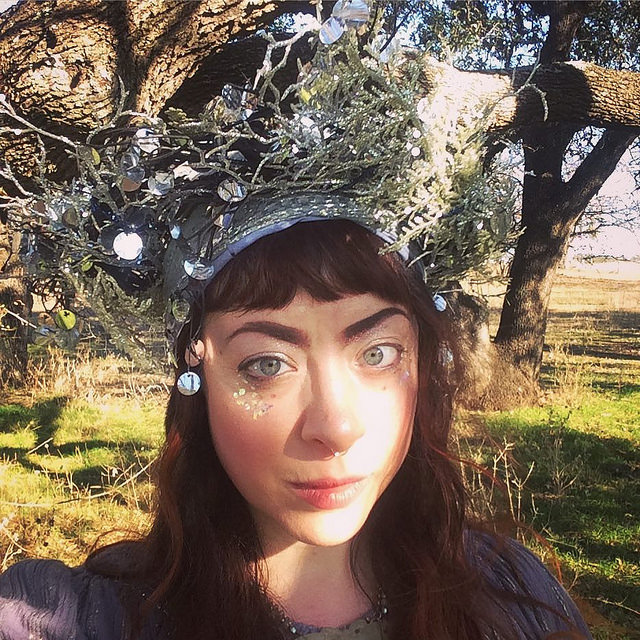
Here I am on the first day of last year, donning a coronet of icicles and sparkly twigs and an attitude of fierce determination to keep my spirits up, to do the work I came here to do, and to do my part to dismantle the motherfucking patriarchy with witchery, wisdom, and an excess of glitter.
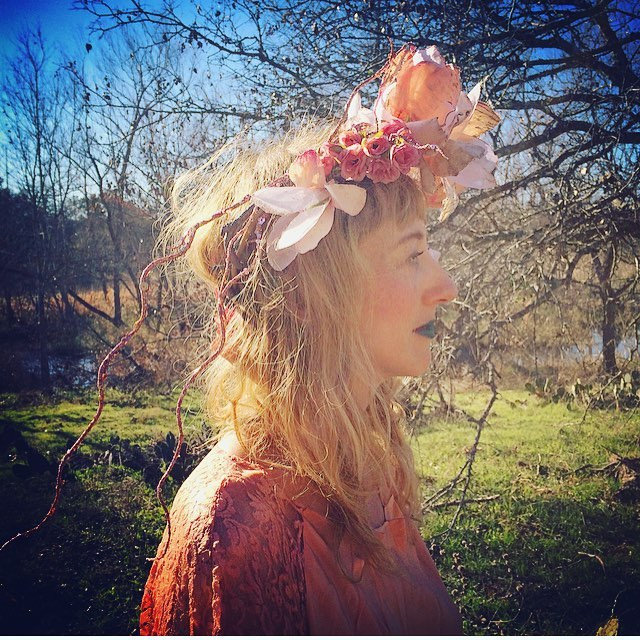
Allyson, a summer queen in the winter garden. This lady has taught me so much about true loyalty and friendship. Her sweet steadfast heart is a blessing in my life.

The lovers ringing it in with the first chess game of the year.
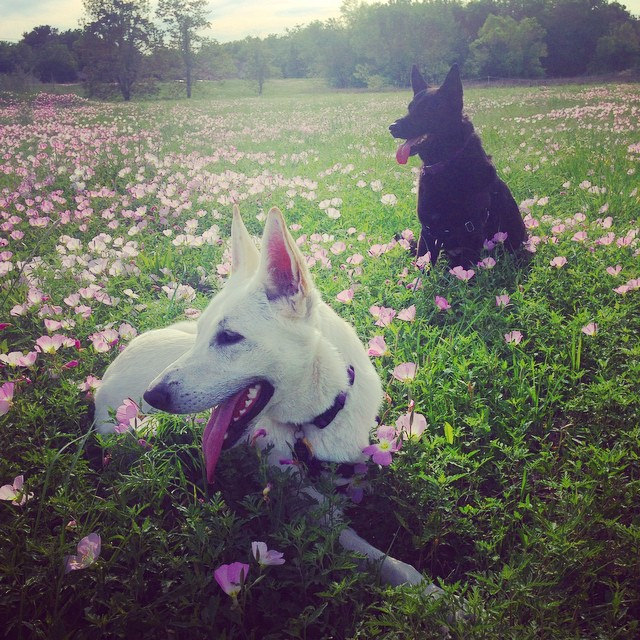
My sweet beasts, my healers, protectors, best friends, number one heroes.

Laughing dogs in a primrose meadow, on a warmer day than this one. I look at these and am reminded that it will be spring again!
I had to step away from my writing yesterday, so now I’m here in 2018, and it’s colder today than it’s been in a long time. It snowed last night as we rung in the new year, here in Texas – for the second time this winter! It’s a rare and wonderful thing, especially considering that this time last year we were camping in short sleeves, basking in the warm sunshine. I know 2017 was just goddamn brutal for everybody, in so many ways – but I think it was also incredibly galvanizing. Many of us have been walking through the fire, and have been tempered in the flames. This past year was one of the hardest, most transformative, and probably most important years of my life to date.
It started off with a series of endings, which took many, many months to heal from. Going through a major Pluto transit is no joke. It’s some heavy lifting. Pluto brings big endings, and I had to say goodbye to so many essential chapters of my life, and people I had loved for so long. I spent the first few months of last year plagued with intense sorrow, paralyzing anxiety, and horrible nightmares. I’d wake every morning to a flock of black-winged harpies taunting me with images and thoughts I didn’t want to see or think about – all the demons of the underworld and my unmaking flaying me alive every night while I slept. From the midst of all the rubble, crowfeathers, bad dreams and fear shits, I somehow emerged – raw bones and ragged edges, hairy legs and all.
I gathered up all the lost parts of myself, and somehow came out on the other side, bruised up, but whole – and wholly myself, maybe more than ever before. 2017 was a year of major growth, and major healing. I’ve learned that those things often come with a healthy serving of pain and heavy work served up on the side, and I definitely had to work my way through before I was able to see the good stuff. It took a lot of trust. Looking back on the year that was, what I learned, and how I grew – I want to feel proud of myself, and most days, I do. But today, on the first day of the new year, I just feel bone deep weary, exhausted, and a little sad.
Grey days and cold weather will often do that to me, as will the endings of things, and uncertain beginnings. I hold a flat round stone that I picked up a year ago today, when I was making some big promises to myself. I hold it in my hand and try to bring in the knowledge and the peace of coming full circle, of coming so far. This year was the culmination of big healing work, and it changed me in ways I am probably only just beginning to understand.
There are quite a few things about my life as it is now that I never could’ve conceived of ten years ago, when I sit and think about it – and I love that, how unexpected our lives are, and how much we can change. I’ve been marveling lately at how much life can change in the space of one year. It seems like an obvious thing, I suppose, but recently I’ve been having a lot of revelations regarding things that seem very obvious, but are now somehow seen in a totally different, newly wondrous light. I hope to keep that sense of wonder and revelation close to my heart in the year to come, and I wish that for you, as well. Things can change. It’s not always so bad. There are glimmers of hope shining in the wreckage. We are stronger than we know.
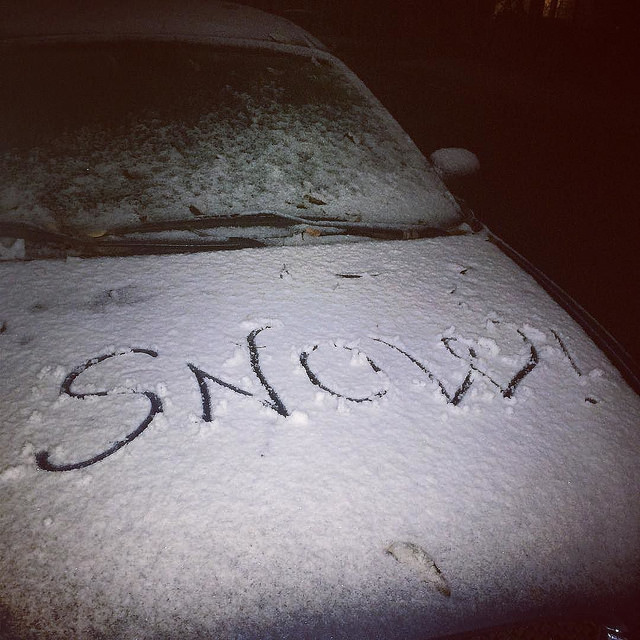
Even a light dusting of snow is a novelty and a strange wonder for us down here in Texas. I love seeing how excited every gets trying to catch snowflakes on their tongues and making tiny snowmen.

Though the full Wolf Moon in Cancer (which is now rising as I write this) tends to be something of a doozy for me, on the whole, I am allowing myself to be serene. For the past week, I’ve been so exhausted, and then when I finally do go to sleep, my heart starts racing and pounding with a strange restlessness. It feels like a message to go deeper, to ground down, to do the things I know help me find calm. I go to my cushion in the mornings, and stay put. I’ve been able to hold my seat in meditation in a way that was never really possible before, and that feels good. Just staying still in my body, even if my mind is still trying to plan and solve, parse and edit and understand.
I’m more comfortable in my skin than I ever have been before, and stronger in my body, because I’ve been doing another thing I never thought I would be able to commit to: working out consistently! This has been a year of intense spiritual growth, with some unexpected paths opening up, teachers emerging from the mist, bringing newfound trust and ancient wisdom. I wish for peace and presence in this bright new year – coming into it with sober and clear eyes. I wish to keep learning how to be gentle with myself, and with others. My wish is that we all keep letting in sweetness, and letting go of the bitter. Let’s keep going towards what feels good, unfurling petals, finding the warmth, and turning our rosy faces towards the dawn, okay?
Let your fierce, feral hearts howl when they need to – and run wild when necessary. We can only be domesticated so much before we lose our souls. Don’t forget – we too, are animals. We too were once wild things. I want to be imbued with a dog’s relentless optimism this year! To keep believing good things can happen, even when the times are bad. My dogs seem to have simple wishes: for full bellies, clean water to drink, lots of cuddles, and lots of playtime outside in nature. What more could we ask for, really? I wish those things for us, too – and in addition to all of that, may you be blessed and protected in this new year, may your heart feel full, may your friendships sustain you, and may you always keep your tail keep wagging, no matter what.
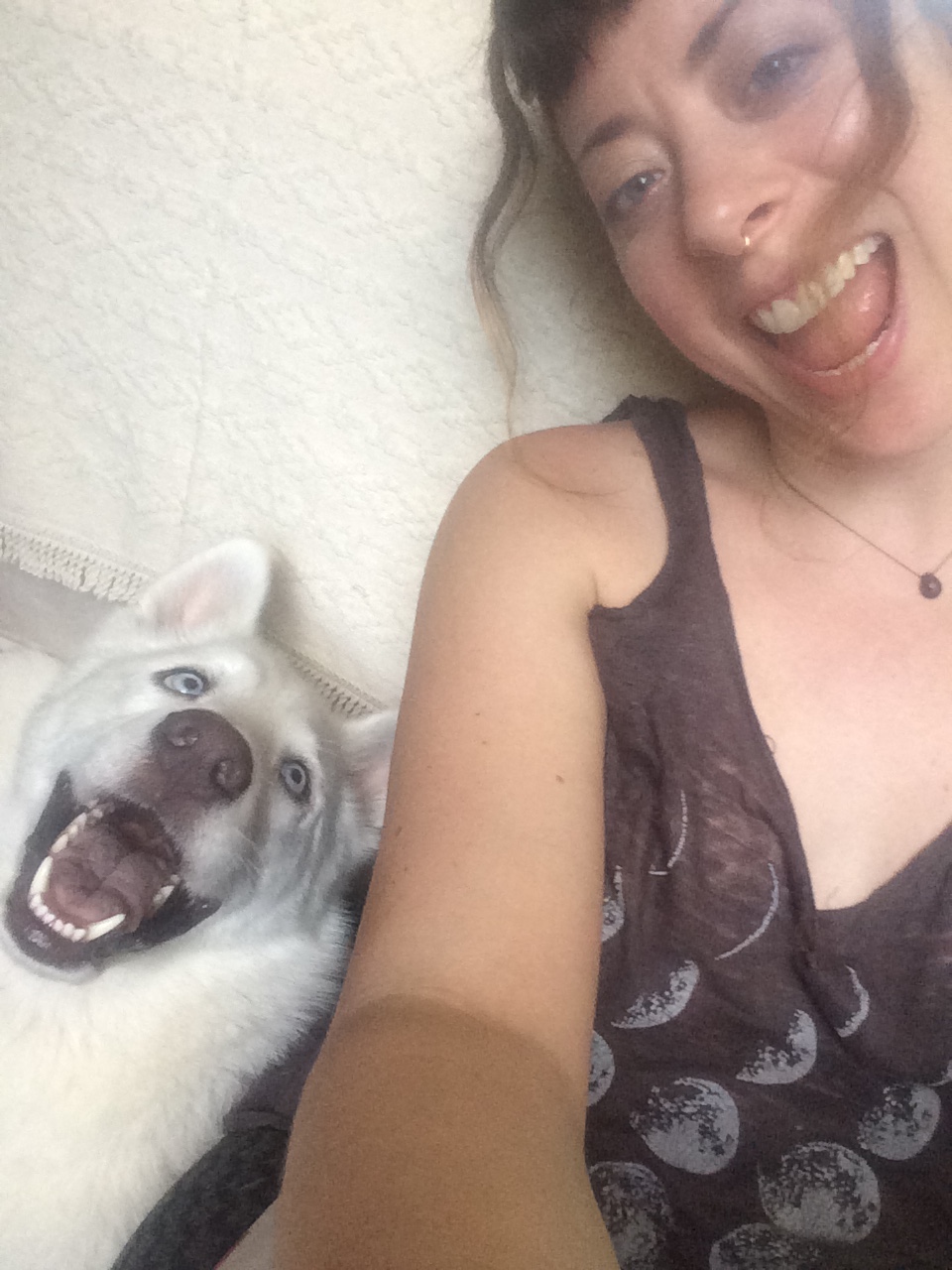
Happy New Year from me and my wolf pack! We love you.
More to read from New Year’s Eves of yore:
✶ THE WHEEL TURNS: A PORTAL OPENS INTO A STRANGE NEW YEAR
✶ OWL WELCOME
✶ AULD LANG SYNE
✶ YEAR OF THE HORSE
✶ NEW YEAR’S EVE FOXFIRES AT THE CHANGING TREE
✶ FUCK THE PLAN 2012
✶ AN EPICALLY EPIC AND FAIRLY TARDY YEAR IN REVIEW – OR, HOLY SHIT: 2011!
✶ A Bright Blue Wish
✶ New Year’s Redux
✶ Stargazer Honey
✶ Blue Moon
✶ Lone Grove New Year
✶ Pink Moons
✶ The New Year
✶ Lucky Stars and Garters
✶ La Nouvelle Année
Winter's Embrace
by angeliska on December 21, 2017
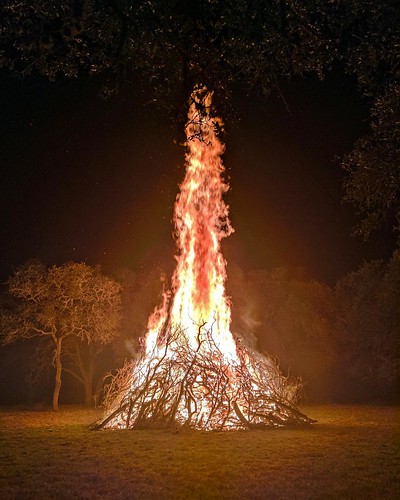
Photo by Clint Redden
Today, the sun stands still – the scintillating convergence of the Winter Solstice is upon us, and at the darkest moment in our winter, the light begins to return to us. That light, the little candle flame inside us needs to be protected – so keep it close, let it build, and shelter it carefully against strong winds, because in these times, if your light goes out, it can be hard to get it going again. A year ago, I gathered with close friends in the country for a ritual to honor the solstice that ended with the lighting of the gargantuan bonfire pictured above. It was one of the most incredible fires I’d ever seen – looming above us nearly forty feet high. The tangle of mossy oak branches stood taller than me! That fire was started with a single spark, one lit candle burning in our hearts, passed from hand to hand around the circle, alighting a massive conflagration that towers to the heavens, the soaring flames illuminating the treetops. A cascade of shimmering embers, fire fairies flit around our heads like haloes and wink out into the cold night air. The incredible heat and blaze was so intense after beginning our Solstice ritual in the cold and darkness – to better honor and value the return of the light! We rang bells, howled and danced around it, calling in that light, soaking up that brilliant warmth. Opening our hearts to that magic.
I’ve been thinking about fire, lately: it’s not the element I feel most connected with, or have been very comfortable exploring. But I’ve been learning about its power, and how much we need it. Fire is sacred creativity, the vibrant spirit, an alchemical force. It keeps us warm, cooks our food, and is necessary in so many of our creative processes. I’ve been thinking about all our elements, and how essential they are for our survival, our balance. And I’ve been thinking about how when we are living out of balance, they react with a fury, often destroying what we’ve built up, tearing down buildings, incinerating forests, drowning the roads, and obliterating the structures that once seemed so permanent and fixed, ripped asunder in the blinking of an eye. I’ve been thinking about the terrible forest fires in California that are changing the face of the land and turning so many homes to ashes. The earthquakes and mudslides, avalanches. Tornados and windstorms. The hurricanes, floods and torrential rains that have been subsuming our cities. We need our water, the blessing of the mother, her tears – the earth, her body – the air, her breath – fire, her spirit. When out of balance, her gifts become terrifying. And yet, perhaps they are still gifts, in some way. Change is happening, and our old ways of being are falling away. We can resist it, but we’ll just exhaust ourselves. Like trying to swim upriver – you can fight the current, but after awhile, when you’ve completely exhausted yourself, the water will take you where it wants you to go anyway, whether you like it or not.
Power like this can be sustaining and nourishing, or consuming and destructive. Staying present, in clear integrity with our higher selves, with open eyes is the only way to retain or regain any sense of balance. I feel that this is also true of sexuality – Eros energy, our creative, generative spark. That passion can keep us warm, support and nourish us, stimulate and inspire our magic and creativity, and open our hearts. Or it can become, like any of the other essential elements, consuming and destructive.
On the Winter Solstice last year, I completed a vow of celibacy that I had initiated on the Summer Solstice. It was only half a year, and yet in those six months, I learned so much about myself, my sexuality, and my approach to love and relationships. But the real work and growth began in the year after I made that vow to myself and took it full circle. From the end of last December until now, I have experienced such radical change and internal growth, that has transformed nearly every area of my life. It feels very vulnerable, and a little scary to write about this here, and yet, I feel moved to share some of my experience, in hopes that it might be helpful to someone who finds it here.
I took a vow of celibacy because I wanted to find a way to channel and focus that erotic energy into my creative pursuits, namely my writing – and because I was in the process of doing some deep healing work on my relationships, and the wounding that I discovered was the origin for many of the unhealthy patterns I had developed around sex, love, and romance. I’m not going to delve into excruciating detail elaborating all the ways, for so many years, that I managed to keep beating my head against the same walls, and finding myself entangled in the same traps and pitfalls, because it would take forever, and really is just too embarrassing to enumerate. What I do want to share is how I discovered that it was possible to break these patterns, and with a lot of self-love and patience, feel like I have finally made some big headway in changing that way of being, and shifting into a new stage of growth. It can happen – but it does take work. Thankfully, there’s really nothing better than doing that human work on this earth. It’s why we came here – to learn, to grow, and to love.
This is the first time in my life where I have felt completely content with my current romantic status – which is, utterly and entirely, wholeheartedly and gratefully single. I think my heart had learned, ever since I was very young, to be in a constant state of longing, of wistfulness and wishing – regardless of whether I was in a relationship or merely burning a fervent torch for one elusive lover or another. It’s a hollow feeling, longing. And one I no longer wish to carry or resonate with. What is it, to be whole – to feel at home and happy with yourself, to be with yourself consummately – and to have that feel like more than enough. I’m discovering that feeling, and delighting deeply in my solitude, in my own company – with no more room for the tugging ache of loneliness in my heart or at my table. Sometimes it’s much lonelier when someone else is right there – so close, and yet so far away. I am right here, and I’m glad to be finally fully embracing these lessons in ways I had never before been able to really grasp. It look a lot of painful twists and turns to arrive at the threshold of this place, and I’m still learning the path. I’ve been thinking about a concept that I believe is from Rumi (as many wise truths are), that the goal is not falling in love – it is to BE love. That’s what I’m after. Starting with learning to be immensely compassionate to myself, even with all my many flaws and failings, all my gifts and shinings. I’m here to embrace my own sweet heart, that I shunned and neglected, ignored and spurned in favor of others, for so, so long. Coming back home, to my own sacred temple, long abandoned, now restored: my heart, my heart, my heart.
But how did I get from there to here? I spent years – years and years and years looking for love in all wrong places. Searching the world over with a hungry heart, hunting for someone to love me, to nourish me, to provide me with comfort and safety and stability. A baby bird looking desperately for unconditional love and validation, for proof that maybe I wasn’t the most awful, pathetic, unlovable creature in the world. Scanning constantly for security, for that person who could be the ONE who would save me, love me, stay with me forever and never leave, never die, never abandon me. And, yet – that loss and longing is all I knew of love. That was my polarity, a familiar home base. I craved love like fire, like water, like a drug. The thing is: that kind of love is actually essential to our survival when we’re little. Human children don’t tend to stand much of chance of survival without their parents, or if their parents (for whatever reason) aren’t invested (via that intense bonding that creates and sustains unconditional love and care. It’s not just a desire – it is actually a need. And I felt that I might die from the lack of it. If it hadn’t been for my amazing father, I very well might have. He has always offered me that unconditional love and care, but after my mom died, he was very overwhelmed trying to provide for us, and dealing with his own grief and broken heart. It was a hard time for us. I was alone a lot, and that loneliness became home for me. It was a place I knew.
From a very, very young age, I developed an unconscious plan for survival: my number one modus operandi became a quest to find the person who would offer me the unconditional love and care I lost when my mother became sick and died – and that in some ways, for various reasons, I never really had enough of before that. I was a practical child, an old soul who figured out the equation early on, and used my kid-logic to deduce that the next best source of unconditional love if you’ve lost your mom, according to all the fairy tales I devoured was, of course – TRUE LOVE! Prince Charming, on his glorious steed, ready to sweep me off my feet and adore me forever. Problem solved. I would be their priority, their everything! And I would finally be safe. As you can imagine, once I hit puberty, this led me to some deeply passionate obsessions with movie stars and later, to many (what I realize now) were seriously messed up interactions with unsavory, predatory people who zeroed in on me like wolves to a lost lamb. I was so desperate for love and affection, and so naive about what love and sex were all about, that I repeatedly ended up in situations where I was taken advantage of because I thought that if someone was paying attention to me, that meant that they loved me. Unfortunately, this continued more or less constantly until I reached near-adulthood. I eventually did wise-up a little bit, but I was still this totally precocious big-eyed starveling who threw myself into relationships and entanglements like my life depended on it – because on a deep, internal level, I believed that it did.
I did have some really wonderful relationships in all of that mess, with a few lovely, kind-hearted people who treated me right, or tried to. Usually though, I ended up feeling stifled and stuck with the people who were actually capable of loving me, and tended to eschew people who were too sweet, not cold or unavailable enough. I’d tell myself that I didn’t feel that magic spark with them – but truly, I was mistaking the sensation of being activated, that push-you/pull-me intense longing for chemistry. They aren’t actually the same thing at all. I’m learning that, and learning so much about my attachment patterns – about which, if any of this is resonating for you, you might really want to delve into studying your own attachment patterns in relationships. Understanding this piece has unlocked so much awareness for me around the loops and stuck places I found myself trapped in for so long.
Taking a step back from all of those patterns and getting some space for myself to establish a new perspective was another goal I had in taking a vow of celibacy. It really had less to do with having sex or not, and more to do with examining what happened for me when I engaged in that kind of intimacy with another person, and my own hidden motivations in finding connection. I want to make something very clear about this: I am extremely sex positive, and believe firmly that everyone’s relationship to their sexuality is entirely their own. What works for one person may or very well may not work for another. All I can share is what has worked for me, and what I’ve learned for myself.
When I was in New Orleans recently, I overheard a voluptuous lady walking by in the French Quarter talking into her cellphone say, “Estoy teniendo tremendo sexo con todo el mundo”, which means, “I’m having tremendous sex with the entire world!” I loved hearing that, especially as I was sitting on a stoop, making out with a very wonderful person at the time. It was a beautiful moment, where the air felt infused with sensuality and magic. I know there are many people out there who thrive by having many partners and exploring their erotic energy with a lot of freedom and playfulness. I respect that so much, and often, I wish it could be that way for me. For a long time, it was. And then things really needed to change. Because I was allowing myself to be in unhealthy situations, and I was getting hurt. I was connecting with people for the wrong reasons – and I wasn’t being especially conscious or present in my choices. The definition of an addiction, as I see it – is when we’re seeking a physical solution for a spiritual problem, and when we’re doing something that we know isn’t good for us – but we don’t seem to be able to stop ourselves from doing it anyway. I saw my six month vow of celibacy as a period of sobriety, during which I was still having great sex with myself (because let’s be real, I’d probably have ended up homicidal or definitely broken my vow, otherwise!) I wanted to be able to come back to physical connection with others from a place that was centered, and compassionate to both myself and them. You see, I’d made a lot of bargains for good sex in the past. I tricked myself into believing that in order to receive that good physical loving, I had to put up with a lot of bullshit from my partners, in their treatment of me. I came to believe that no one else was going to be into the way my body looked naked, or find me attractive or desirable. We find incredible ways to lie to ourselves, and then trap ourselves in feedback loops, get hooked into partnerships that aren’t sustainable or even particularly enjoyable.
It’s like this: when you’re starving, you’ll eat almost anything, right? If you go into a convenience store when you’re really hungry, almost any crap in there seems like it might be delicious. But there’s no really nourishment in a bag of Cheetos, and it doesn’t tend to last very long anyway. When you stop by the gas station with a nice full belly, you’ll find yourself realizing that there’s really nothing in there you want to eat, nothing you want to put in your body. A lot of the relationships we end up in when we’re operating from a place of inner hunger are the equivalent of junk food: addictive, extremely flavorful and delicious in the moment, but ultimately – they just end up making us sick. Learning how to feed my own heart and tend my own inner fire helped me have much more discernment around who I choose to share myself with than I ever had before. Sex on the first date was just a matter of course for me, and I would leap into situations with people without knowing them very well. I used to have basically little to no restraint, when I would actually meet someone I was attracted to – which is a rare enough occurrence, that thankfully I didn’t get have too many opportunities to create havoc for myself. It was much worse when I was way younger – and had no idea what I was really even attracted to. I have a lot to unpack about that time in my life, and what those experiences were really about. I’m working on trying to understand it, and heal it.
As Saturn moves into Capricorn this month, we’re being given a message about truly taking responsibility in the way we move through the world, and realizing how our actions effect other people. This is a good time to examine your boundaries, and your own personal rules about sex and relationships. A sense of soberness and a more serious approach may be replacing some of the unabashed hedonism of our past exploits. It’s a good time to perhaps be more judicious in our interactions, particularly because we’re really talking about consent, about boundaries, and about desire. This is a powerful time to have these conversations together – about what we’re really doing when we’re sharing the experience of sex and intimacy with another person. We’re finally having the conversations about how often we’ve had sex in the past we really didn’t want – or felt pressured into. When just doing it was easier, (or felt easier at the time) than saying no, or extricating ourselves out of these situations. In creating strong boundaries for ourselves and our partners, and making space for clear communication about what we want, and what we don’t, we are shifting the paradigm. There’s a lot of power in reclaiming that energy for ourselves, and in healing the wounds around our sexuality, and the ways that it may have been abused, exploited, coerced, or mis-used.
Our world is changing so much, and so quickly. I see so many of these changes being for the better – especially as we shift into a new way of relating. I think about the fact that for ages, if you wanted to get to know someone, and especially if you wanted to have sex with them, you had to get married. In this era, we have the freedom to take things slower, to really get to know someone. It’s been said that you really don’t know someone until you’ve spent four seasons with them, and I think that’s true. What would it be like to not make any big decisions about a relationship until you’d taken that time? When we start getting high on love drugs, which is what happens when we start doing stuff that releases oxytocin and vasopressin, like having sex, it makes us a little crazy. And it makes us bond with whoever we’re doing that stuff with. Which can be awesome. Or catastrophic. Because sometimes those bonds are not really appropriate – for various reasons. It’s very, very difficult, from even just a biological standpoint, for casual sex to stay casual for very long. So, as much fun as that can be (and often was, for me in the past) I’ve chosen now, after everything I learned from just hanging out with myself for awhile, that casual sex doesn’t work for me. I’m too sensitive, and too serious, and I just really don’t want to share myself in that way with someone who may not really care about me, or care to get to know me. And vice versa.
Sex is a ceremony, a mingling of our essential energies. It is sacred, if you approach it from that place. I’m interested in exploring, in getting really curious about a lover, and experiencing the same from them. I realize now that when I was coming from a place of need, and needing my partner to fulfill a space of lack in me, I didn’t allow much room to just discover them, and to be curious about really getting to know them as they were. I was just expecting them to uphold a certain way of being to make me feel safer, and then would get upset when they would turn out to be someone different from who I really wanted. It turns out, there’s something to be said for really taking your time! I’ve been relishing that, and also relishing saying no – something that was so hard for me to do, for so long. It gets easier and easier, and it is very empowering, to have that choice for myself, about what feels right for me – to get a clear sense of what works, and what doesn’t, without making a lot of concessions. I’ve been dating, for the first time in my life – a little bit, here and there. It’s pretty fascinating, honestly. And a little odd to be in a place where I’m not looking for casual sex, or a hookup – but also not convinced that I’m interested in getting into a serious, committed relationship again. Being partnered takes a lot of work, and it really is an enormous responsibility. It’s not something I ever want to take lightly again. Until I meet someone that really feels right, I’ll keep channeling eros energy into my creativity, into my writing. Sometimes, I fall into the fearful belief that I can’t be focused and productive if I have a lover in my life. I get afraid that if I meet someone I really connect with, I’ll lose myself again. I imagine scenarios where we get so high on from lovemaking that I’ll want to do nothing else but roll around in bed and then make blueberry pancakes and spend all day feeding them to each other and then rolling around some more. Maybe that wouldn’t be so bad? Everything in moderation, right? It feels good to wait and see, and not to settle in the meantime for something that feels like a compromise. Compromise really means that one person gets what they want, while the other one doesn’t – and it’s interesting to me how often we’re told that we need to compromise in our relationships. I’m interested in collaboration – where we can both figure out how to mutually get what we want! It feels good to hang out in this space of not-loneliness. I still crave touch, of course – and sometimes that skin-hunger can be a little distracting! We need touch, as humans. But there are ways to receive it that feel healthy, and allow me to stay focused. I know I’ll touch and be touched again when the time is right, and when the stars align to put the person or people into my path who will teach me the next round of lessons: this time on true intimacy, on receiving love, on trust. I think that will probably be a little terrifying, or maybe a lot – and I’m excited to get out of my comfort zone of being alone and discover what real connection feels like.
As the sun is returning – the warmth is flooding through the earth’s body, and I feel it too. I went dormant for a long time, last year. Trauma can do that, sending the body into freeze mode. I shut down a bit, buried my spark deep beneath the earth, like a precious seed. But all this time, it’s been gestating, growing invisible roots, deep and strong. The ice over the water is breaking, and I’m cracking open like a pomegranate.
My sexuality is mine, and I am my own best thing. I preserve my sacred inner fire, honoring it for the precious thing that it is, and build it, stoke it so that it will keep me warm on cold nights. For now, it is for me, and me alone. My choice to share it will be based on mutual understanding, instead all the old reasons. How exciting it is to approach love now with this discernment, and to enter winter’s embrace with a bright flame in my heart, a beacon, calling in the new ways, the new loves, the new lessons. May your Winter Solstice be full of warm embraces, and may we all learn more this year, and throughout our lives in these bodies, about how to love, and to be loved.
My writings from Winter Solstices of yore:
☾ NORNS OF WINTER – SOLSTICE WISHES
☾ SOLSTICE SISTERS
☾ PERCHTA
☾ POMEGRANATE STAR RITUAL FOR THE WINTER SOLSTICE
☾ COLD WINTER MOON, SOLSTICE BLUE
☾ WINTER SOLSTICE – BRIGHT STARS + FIRELIGHT
☾ WINTER SOLSTICE – BLOOD MOON
☾ Winter Solstice – Messe de Minuit
☾ Winter Solstice – Dark Season
Lissa and the Lion
by angeliska on October 10, 2017
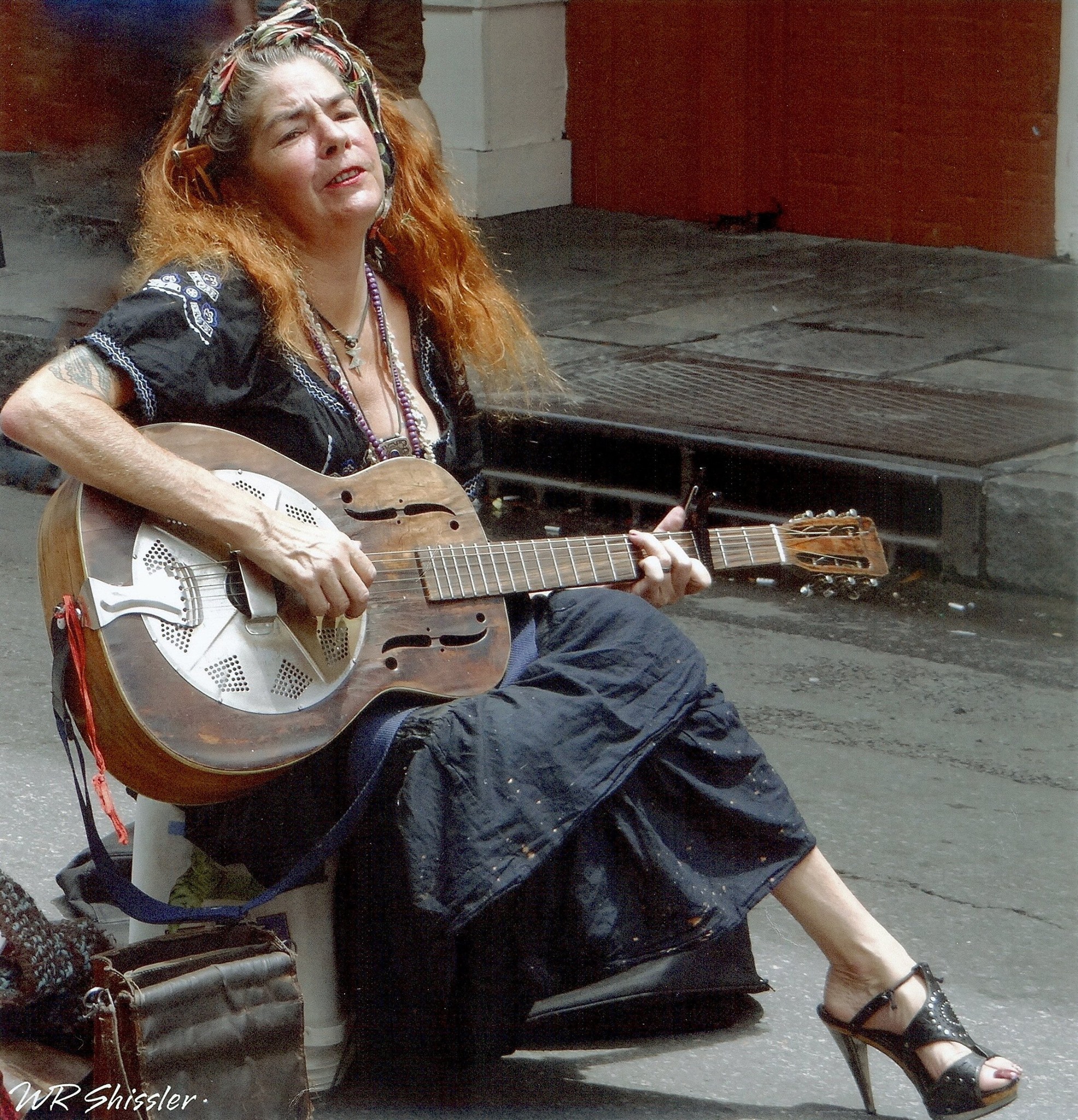
I met Lissa (pronounced like “Lisa”) Driscoll nearly twenty years ago, when I first moved to New Orleans. I was only 19 or 20 then, and had just started working at an occult shop in the French Quarter notorious for its staff of saucy witches and reputation for casting a lenient eye towards magic that strayed to the grayer side of black. Lissa worked there too (in her odd way), and I learned the ins and outs of divination, and selling herbs, candles and other occult goods from this woman who was the kind of bohemian “free-spirit” the French Quarter used to be overflowing with: the kind of wild lady the famous Storyville sign, “BEWARE PICKPOCKETS AND LOOSE WOMEN” seemed to be warning about. I remember she had one of those signs hanging proudly over the stove in her kitchen. When she wasn’t slinging tarot cards, and ritual daggers, you could find her belting out songs and beating on a washboard down on Chartres or Royal St. on sultry afternoons, rain or shine. Lissa favored raucous old time songs and the rowdy men who played them with her. She’d arrive to work at the crack of noon with a big bottle of red wine and a black peppered salami from Matassa’s in her bike basket, and would proceed to spend the day holding court from the antique armchair in the corner, its stuffing pouring out in white curdles around her strong legs. She’d roll countless cigarettes with Bugler tobacco, tell bawdy stories and work her way steadily through the cabernet and the salami until we closed at 10, when she’d wobble off on her bicycle to go tear up the night, or back to her cozy roost: half a shotgun in the Bywater always filled with fellow musicians and friends. I got invited there for my first Thanksgiving in New Orleans. I didn’t know many people then, and I guess the people I did know were with their families, so I found myself at loose ends with nowhere to go for the holiday. Lissa’s house was steamy with good cooking and warm with company, all who welcomed me as if I’d been in town all my life. Biking home that night with a full belly and new friends, I thought, “It’s gonna be okay here, after all.” I had been feeling pretty alone, and little trepidatious with the process of trying to find my way in a new city after leaving my hometown for the first time. I’ll always be grateful to Lissa for really helping me trust that New Orleans was the right place for me to be.
Washboard Lissa was the real McCoy – realer than real. She had no time for phonies, posturers, stuffed suits, or any of the pretentious fools pretending to be vampires, warlocks or voodoo priests that would flock to the French Quarter hoping to impress the naive. I watched her guffaw many poseurs out of the witch shop right out onto the banquette, their black tailcoats tucked firmly between their legs. She was frequently laughing – a raspy, good-natured cackle that would split her face in two like a walnut, teeth glinting and flecked with shreds of loose tobacco. Her skin had a ruddy cast, from hours busking in the sun, and her face was slightly weathered, but surprisingly unwrinkled. Untamed brows nearly met in the middle over dark eyes always squinting through laughter and glinting with sass. Lady werewolf eyes, feral and alluring. Her long hair seemed to float down her back, as if with a life of its own, brown as a wren, or sometimes hennaed red, and silvered in wavy striations, looking always as though it had recently been taken out of many tight braids. Though she didn’t shave her armpits, and I don’t remember her wearing much makeup, she was exceedingly feminine in the way of Belloq’s famous whores: not a classic beauty, or even quite pretty exactly, but she gave off such a brash aura of raw and somehow innocent sexuality, that you couldn’t help but be totally disarmed by her. Lissa had the total lack of insecurity or self consciousness of some woodland creature: a swamp witch fond of wearing long flowing vintage dresses, usually backless, braless, and often sliding off her shoulders. Her brown areolas seemed constantly on the verge of making an appearance, and her belly was beginning to get a slight baby bird booze bloat, centering her gangle of gesturing limbs. Being as young and dumb as I was at the time, I had no concept of how to judge someone’s age if they were much older than 30. I’m guessing she was in her 40’s, but she was a hard-livin’ lady, so it’s kind of tough to say for sure. I hadn’t seen her in a long, long time – not since way before Katrina hit in 2005, but I still remember a story she told me about when she was a little bitty girl. I’ll relate it as best as I can, though it’s been years since I first heard it, and so over the years and many recounting, my memory may have taken quite a few liberties. I got in touch with her a few years ago, and we struck up a correspondence, during which she got to read this piece, and make her corrections. She was entertained by it, and thankfully didn’t mind me stitching some fanciful embroideries around the edges of her story.
When Lissa was maybe 8 or 9 years old, she went camping with her daddy – I want to say out in Colorado. They were up in the mountains, and had been set up there for a week or more, hunting some, I guess, or just being in nature. I don’t know if her mom was with them, or where her mom was, but I always imagine this story to just be about little Lissa and her dad. I picture him looking just like Sam Shepherd, with that same gentle wise smile, and a bright spark in his black eyes. You’d know from looking at him where his daughter got it from. A man of the woods, of the backroads. Quiet of footstep and a calm, sure shot. The huntsman with a heart of gold, like in the fairytale. Snow White as child of the forest, adopted instead and raised by her savior, the woodsman – no gnomes or prince in sight. I like thinking of it as just the two of them living for weeks out-of-doors. The way you start to set up automatic systems of survival in the woods: waking with the first light, cowboy coffee and oatmeal, gazing out quiet over the small smoking coal-fire in the cold and golden dawning, clutching tin mugs in this wild place not quite their home. Letting the grouse’s song be their only conversation. Wash up, hang the grey wool socks out, get the food up put up tight where bears won’t be tempted. Not too many people out on the mountain, this far into autumn. After the camp’s cleaned and tidy, Paw goes out to hunt, and leaves Lissa free to do her thing, which is mainly to wander off in the opposite direction down the trails, while he goes out into the brush and thicket with his rifle. He trusts her to mind herself in nature and not do anything foolish, and she’s old enough to know what to watch out for – the signs of predator scat and big tracks. She goes off with a tin bucket, whistling a winding song that becomes a chant, a whisper, a garland of secrets, child-spells. A language of her own, from so much time spent alone in the green. The singing sends any animals out of her way, and out towards Paw, or that’s how they think it might work, anyway. She knows not to go too far, and to make a bobwhite call from time to time, so he’ll know she’s alright. Off she goes, swinging her berry-bucket, knees scratched and dirty, hair a soft cloud tangled with seedpods and milkweed fluff.
He, her Paw, is looking for a rabbit, or deer, or turkey, or even that grouse that was singing bright so early. He knows how to be completely still in the woods, listening, quiet as a tree. For a long time, there is no sound other than his slow breathing, and the chew-whit-pip-pip of a gnatcatcher. He know how to wait in perfect patience for that rustle in the underbrush, the scatter of dry leaves and cracking twigs that might reveal dinner, or something more dangerous. A couple of times he thought, maybe – rabbits, and got happy thinking of the stew they might cook up that night. But it was only a weasel, and he wasn’t quite that desperate, or really even quick enough. After a long time waiting, a different sound began to unspool itself from back up the trails, like a tape unwinding itself backwards. A wrong sound. Screaming. It sounds like a girl-child screaming and screaming. He busts out of the brambles with a father’s fury, no longer trying to be quiet at all – but then has to stop on the trail to pinpoint her distress call. He runs back towards the terrible sound, brandishing his gun already at whatever is hurting his daughter: a bear, a wolf, a bad man. But when he rounds the bend and sees her up near the trailhead, it’s none of these imagined enemies that has got to her, is attacking her. What he sees is there far worse, because he can’t quite get his mind around what’s in front of him. An enormous mountain lion is standing on its hind legs, huge paws wrapped around Lissa’s shoulders. Her berry-bucket is overturned in the gravel, little yellow dress stained dark with red. Now is the time where he must focus, save his child from this monster that is currently ripping out her throat, or tearing off her face, its velvety head twisting eagerly at her neck. Everything slows down and he can hear the lapping tongue of the cougar, the high-pitched shrieks coming from Lissa, his own heart beating hard. A deep breath in and out, and squinting, Paw struggles to get a bead on the beast. If he pulled the trigger now, firing directly into the cranium of the cat, he’d risk blowing her brains out at the same time. He has to wait until he can see her face, and the take that window quickly. Hands shaking bad, now. He could miss. It might be too late anyway, she’s probably near to bled out by now – how is she even still standing? Half tempted to just throw down the rifle and rush the damn cougar, let it take him. If she dies, life won’t be worth living anyway. Still aiming, the window comes – for a half second he can see her face when the cats flicks its ears west, and times starts to speed up again: Lissa’s little elfin face changing expressions rapidly – but strangely, from delight to horror rather than the other way round, and then a figure moves into the clearing shouting, “Sheena, DOWN! Sheena, COME!” The mountain lion immediately releases the girl, gracefully lowering down to all fours and moving in a long dun stream towards the interloper: an old woman, gray hair wrapped up in a scarf. They all stand there, dumbfounded for a moment. Lissa’s dad lowers his gun, realizing that the sounds he’d interpreted as cries of distress were in fact squeals of ticklish laughter. She’d been screaming and screaming with laughter, with joy – communing with this beast. Lissa is running up to him now, Her cheeks and hands are stained red from raspberries, despite the sandpapery attentions of the mountain lion, shouting “Pawpawpawpaw! Did you see?! That big ol’ cat jumped up on me and was licking my whole FACE!” The predator is docile, an overgrown kitten, rubbing up against the woman’s leg. She says, “I’m so sorry – usually no one else is up on the mountain this late in the year, and most folks that are already know Sheena. She was rescued from some bastard that had her declawed years ago. Usually she keeps close, but today I got distracted and let her get off down the trail. I see she found a friend…” He shakes his head slowly, trying to work it out, willing his bowels to return to solid form again, gazing at his happy, living daughter dancing with excitement in the dusty path. The sun is westering, it’s time to get back to camp, huntsack empty of game, but he has no taste for flesh tonight. He takes Lissa’s small sticky hand and they turn back towards the place that stands for home, for now – and the comforts it provides. A fire to stare into, a little whiskey to calm his thumping heart, and this story she will happily regale him with all night, and into the years to come. Weeks from now, months, he’ll tell it too, and then he’ll be able to laugh with her. Tonight, he will stay quiet and watch her berry-stained face blushed copper in the firelight, singing her favorite old songs.
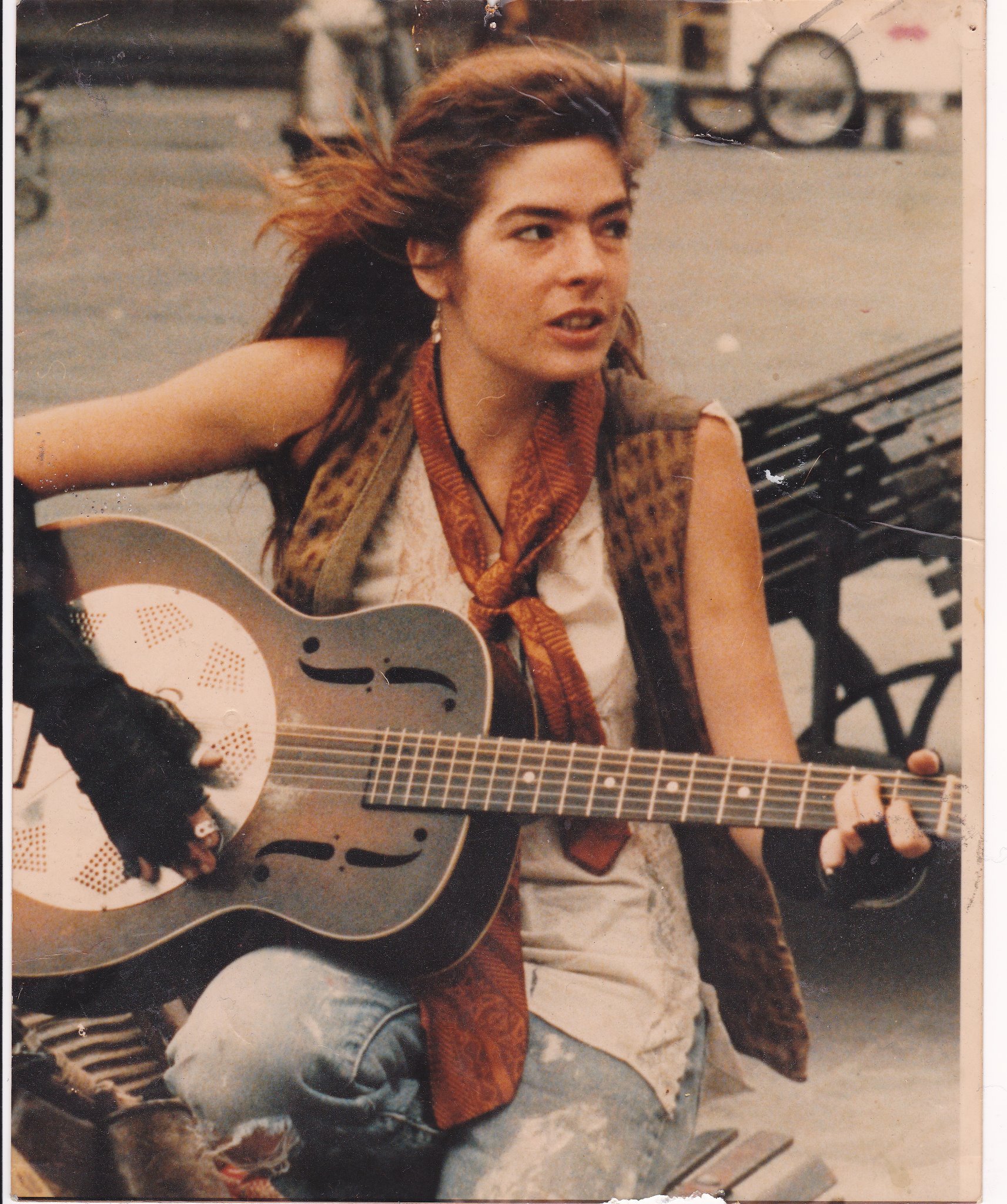
Lissa slipped her skin this past September, after many years of truly living, as one of her friends put it, “like someone truly alive”. She had gone up to Quebec City to be with her beloved mother who was dying, while also struggling with lung cancer herself. In a letter to a friend, she wrote about her retreat from social life, in preparation for her death, describing herself as, “embracing solitude without distractions”. She also shared this:
“My mom had this quote on her fridge from Baudelaire in 1829.
‘I have quite given up the social struggle. I have scratched from the race of life. I have a room for 400 francs a month and at last will be living within my own and other peoples income.’ I think that parts funny but he goes on. ‘I am tired of acquaintances tired of friends unless they are intelligent tired also of extrovert unbookish life. I am for good talk wet evenings vins rouges en carafe reading relative solitude street worship shop gazing alley sloping Seine loafing exploration of the least known arrondissements and plenty of writing from this table in the window where I can watch the streets light up. I am far past the north. The world of ideas. I am for the Hotel de la Louisiane.’”
I am imagine her inhabiting that world now, forever. Long live Lissa!
R.I.P. Lissa Driscoll (a.k.a. “Washboard Lissa”) – left this world of from at 12:45pm, on September 14th, 2017
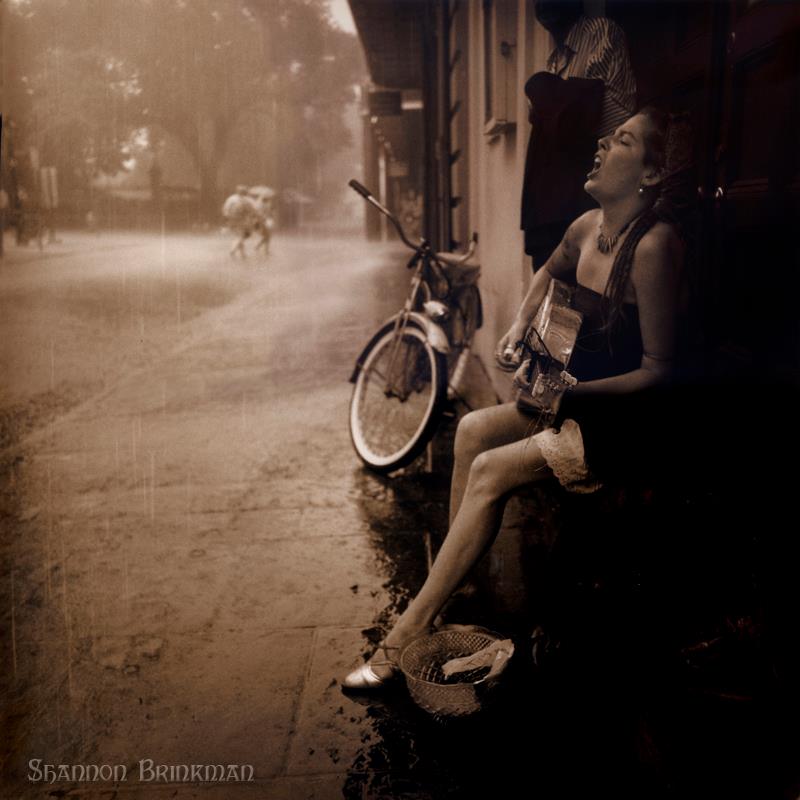
Photo by Shannon Brinkman who said, “Bye for a little while, Lissa.
We will remember you for all the moments you here and especially when we got to join in for more.
Here is Lissa back in late ’90s doing her singing rain or shine in a spot near Jackson Square where Chartres curves into St Peter.
I will remember this moment always – thank you.”
From WWOZ – In Memoriam: Lissa Driscoll
I was listening to this Odetta song when I found out Lissa had left us. It felt like a perfect serenade:
No it ain’t no use in callin’ out my name, gal
Like you never done before
And it ain’t no use in callin’ out my name, gal
I can’t hear ya any more
I’m a-thinkin’ and a-wond’rin’ wallkin’ way down the road
I once loved a woman, a child I am told
I give her my heart but she wanted my soul
But don’t think twice, it’s all right
So long honey babe
Where I’m bound, I can’t tell
Goodbye is too good a word, babe
So I just say fare thee well…
12 Years – Katrina/Harvey
by angeliska on August 29, 2017
Today is the 12th anniversary of Hurricane Katrina. Fittingly, the first hurricane lily bloomed today, here in my garden. Symbol of hope, autumn’s harbinger, bloody reminder of the season of storms. I didn’t intend to pick it, but Snowy tried to bite the blossoms as I was marveling at its beauty, and I had to pluck it, lest my newest wolfling beastie devour this precious flower.
In the days leading up to Hurricane Harvey hitting Texas, I was far away from home – visiting friends in Oregon after seeing the solar eclipse. I often find myself traveling around this time of year, trying to avoid the hellish heat of late August temperatures in Austin – but that means I put myself in this strange position over and over again, of worrying helplessly about hurricanes in the Gulf approaching the cities I love and call home. You never really know until the last minute where they’re going to hit – will New Orleans get socked again, or maybe Mississippi? Or this time, Texas. I almost changed my flight to come home early, fearful of getting stranded in the Pacific Northwest if flights ended up getting canceled. Reflecting on the journey home, it’s kind of a miracle they didn’t – considering how brutal our landing was. As we circled the airport, the pilot struggled against powerful winds coming off of the big, blowsy bands of Hurricane Harvey. His expert flying kept us aloft, but my stomach roiled in protest, and I was breathing deep like a lady in lamaze class, not sure if I was more worried about throwing up or shitting my pants. It’s weird how our bodies react to fear. In my heart, I felt calm. Turbulence doesn’t usually bother me too much, and I’m not generally afraid of flying. But trusting the tin can you’re sailing through the air in to survive hurricane force winds is maybe another story altogether. My anxiety was subliminal, manifested in the mostly unconscious gnawing and mutilation of my own finger-skin. The lady seated next to me was from Eritrea, on her way to visit family. She didn’t speak much English, but smiled at me brightly with silver teeth, graceful in her bright jade green dress and shawl. When the plane started bucking like a wild pony, I noticed her hands white-knuckling the arm-rests, and then crawling uncertainly over her belly, in nervous gestures, seeking something solid to hold onto. I offer her my hand to hold, but she didn’t understand me, and clutched tightly at the tail of her seatbelt instead. A muttered, looping prayer, “Jesus’ name, Jesus’ name, Jesus’ name” under her breath, which became a joyful exclamation to me when we finally landed safely. The whole plane clapped ecstatically for our intrepid pilot and his expert flying, grateful to be alive and earthbound once more. I was too shocked to applaud, dazed, half of my soul still hurtling through heavy clouds. I don’t think I realized how dire that rough landing truly was until it was over. I remember flying home from Spain to New Orleans, late at night on August 27th, 2005. We were flying through what I think must’ve been the outer bands of Hurricane Katrina, barely a day before she made landfall. I had a window seat, and I peered out the portal as we flew over a massive storm cell, brain-like clouds pulsing with lightning. It was ominous, terrible, and incredibly beautiful. I didn’t know what it was – was completely ignorant to the fact that a huge hurricane was barreling towards my city. I hadn’t been keeping up with the news on my travels, and no one had been talking about it. So I laughed. I cackled with elation at this awful, gorgeous storm – unknowingly at my own (and so, so, so many others) incipient devastation.
Once thankfully deboarded, I made my through my leaky hometown airport and out into the stormy night, finally headed home. My aunt Ruth had stayed at my place with my dogs while I was away, and had been cooped up with them through the first waves of Harvey hitting and the wind outside “blowin’ a gale!” She had told me many times about how much my mother hated wind, loathed strong gales tearing at the house, or even an electric fan blowing on her face. Drafts and anything but the gentlest breezes were her bane – and I understand that very well, because I’ve always been the same. She kept remarking on how much my mother would’ve hated this weather, saying “I’m with your mom on this one – I’ve had enough of this wind! I can handle wind when it’s just talkin’ to you – but not when it’s screaming in your face like this!” The next morning, she packed up her things and got the hell out of dodge, to Lone Grove, where the sun was shining. I sat on the sofa, home and quiet and alone for the first time in many days, and listened to the wind sing her banshee song. All night long, she’d been keening, pulling at the trees, and raining, raining, raining. I was trying to find the joy in the rain we were getting, knowing this soaking Austin was receiving would be a boon and a blessing to our parched earth. Knowing that so much rain heading towards Houston would be a curse, a ruination. This was no ordinary summer thunderstorm. Big hurricanes, major systems like this, they just sit on you for hours. Squatting on your chest like a wrestler, taking you down for the count. The fear felt heavy on me. I read something else recently, about anxiety – that it’s okay to be afraid, to acknowledge the presence, the reality, of that fear. It’s real, it exists. But we don’t have to let it take us over. I’ve been thinking about all my New Orleans folks, whose anxiety and PTSD symptoms go into overdrive around this time of year, even when not horribly triggered by seeing a repeat of what so many of us went through. Seeing it happen all over again, to new people. I was reading posts from my friends in New Orleans today about how they used to be all about going to a hosting “hurricane parties”. You’d hole up with your booze and your beer, your chips and your cookies and whatever creatures comforts would hold you through (oh yeah, and maybe some water, candles and a radio” and then you’d invite friends over to get drunk and party until the thing blew over. Unless it didn’t. I’ve never been to one of those. I always got the hell out when I could, not willing to chance it. Or sat at home feeling terrified. My friend wrote that she couldn’t believe that now, after Katrina, she finds herself being afraid of rain. Just rain. But there’s rain, and then there’s hurricane rain. When you’ve lived through the difference, when it’s totally fucked up your life – you come to fear something as seemingly innocuous as that. I get it. All day the storm hovered, pressing down, bringing with it the strangest combination of boredom and tension. The weather felt like a long labor. Being stuck in it, nothing to do but ride it out, wave after wave of intensity hammering down, followed by strange deciding bands of calm in between. Shiver, shake, try to sleep. Feeling anxious, unsettled, just wanting it to pass over. For hours and hours, the air weighty with moisture, turbulent, humid and leaden. Interminable. Sweat beads your brow, your upper lip. Look out the window, walk around the room, breathe. Think about how it must be for people who are really getting it. Seeing Houston filling up. People stranded on roofs. Flashback to twelve years ago. Families trying to get out. Feeling helpless. Click refresh, watch and worry, call and text, go through the list, check in. Share information, donate money, rally volunteers. It doesn’t feel like enough, and it never will. It’s happening all over again, and it’s going to keep happening. Lives imploded, soaked, stopped mid-sentence. The shelters are swelling, the numbers staggering.
Shattered saints. Houston is underwater, many of our coastal towns are utterly obliterated, & countless people here in Texas are displaced, their homes destroyed, their livelihoods lost. I remember that feeling well, & my heart is seizing up for those frightened, wet, and despairing people now crowding into shelters & still being rescued. So many lives, shattered and sodden. It’s such a goddamned hard thing to go through, y’all – try to imagine everything you’ve worked so hard for, just swept away overnight. Having to start over from scratch. Rebuilding a life from the ashes, from the dregs if what could be salvaged. I did it, 12 years ago. I’m not whole, all this time later – but I’m stronger, & I’m so grateful for all the help I’ve had. I still have the head & shoulders of my Santa Barbara statue, seen here smashed in the wreckage of my old kitchen in New Orleans after Katrina tore my roof right off. We survived – broken, but still here. I know I am protected. I extend all my blessings & deep prayers to everyone who has been affected by Hurricane Harvey. If you can, please do the same – & donate, volunteer, reach out. It all helps.
It’s heartening seeing how many people are stepping up to help, and as always, it’s the only good thing, the only bright light in situations like this. Human connection, compassion, the warm feeling we get from helping others. I donated money today, to Circle of Health International (more info on them below) and directly in cash to my friend who is working to put cash directly into the hands of evacuees who desperately need it, immediately. I’ve been keeping it together, for the most part. But when I put $200 in my friend’s hand, and she said she’d give it tomorrow to a family of 12 who had nowhere to go, I felt the tears rising. Thinking about them, piling into the back of their van, children and grandmother and everyone, laying on top of each other to fit. I hope it helps, I hope they get settled, get safe. I cried, thinking about all the people who stepped up and helped me out so generously when I evacuated from New Orleans to come here. I had so much help. People were really kind to me. It made a huge difference. I remembered tonight, sitting outside in the bright porch light at my friend’s house, Andrei Rusakov, of Moscow. He had come across my blog when it was on Livejournal back in 2005, and he contacted me to tell me he was wiring $200 to Western Union to help me out. He wrote to me, “You have an account where to transfer money? It is the first part of my help for you. Now I can help only so because I am in Moscow. In the further I can help to restore your collection things from Russia and from Portugal. Also I shall make all that will be in my opportunities! You will not remain one in the trouble!” He also wrote, on his own blog, this – which I poorly translated “Of course she will not be left alone with her misfortune. And for a long time I will explain how and why this person is so dear to me and how terrible for her is the loss of this house and all these things.” I saved these words, and have pulled them out a few times in the past 12 years, to remember this distant stranger’s kindness to me. And there were so many instances like that, so many kind friends and total strangers who offered me help, sent treasures, became dear to me. These are the kinds of personal connections, in terrible times, that really stick with you. So, I guess what I’m saying is, if you can, try to make connections like that with people who need your help right now. It will change things, for the better, for both of you. You can easily click a button, and send money. It helps, it all helps (especially if you can donate to smaller, local grassroots organizations rather than the Red Cross.)
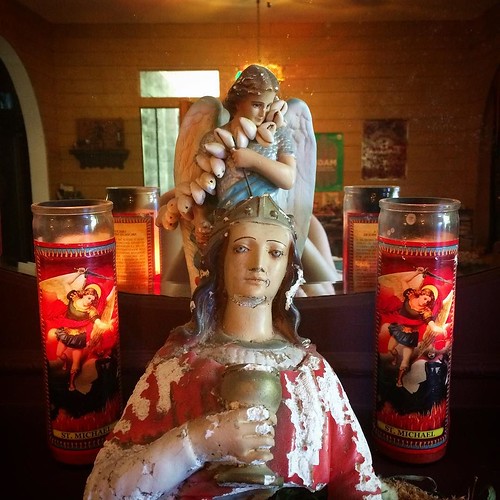
Burning candles to St. Michael Archangel (patron guardian of first responders, those in boats, & the sick and suffering) calling for protection & healing for everyone hurting right now in the wake of Hurricane Harvey, and still, 12 years after Hurricane Katrina. It’s crazy how much you can lose in that water, y’all. It’s not just stuff, not just your house or your car. You lose time, your sense of it, and the actual days, weeks, months, years – to cleaning, crying, rebuilding, being exhausted, worrying, staying strong. You lose your people, your community, your way of life, your natural rhythm. A disaster like this throws everything off. Nothing is ever the same – not ever again. But some things survive – like the half-shattered bust of my beloved Santa Barbara, almost totally destroyed in Katrina, who I once carried (in her entirety) on an epic journey through the Lower East Side to be serendipitously blessed in the park by drumming hands and voices calling out to Changó. I’ll tell that story one day. Today, I breathe and write and pray – I honor the dead lost in the floods, this week and 12 years ago, I send love and strength to the living struggling to come through the storm, I beseech the gods of lightning and the storm goddess to be gentle to us down here, please please please.
For everyone looking to help out right now, I want to recommend donating funds to Circle of Health International, who does such bad-ass hands on, boots on the ground work making sure mamas and babies have everything they need for their safety, survival & wellbeing in disaster situations. They’re based here in Austin, & are doing great work to help those in Texas affected by Hurricane Harvey!
Here’s some info from them:
Live from Texas: Thanks to YOU our friends + allies out there on the interweb COHI will be giving out our 1st round of cash grants to low income #hurricaneharvey evacuees in #ATX who are expectant parents and families with newborns tomorrow. These grants will cover costs for things like hotels, buses, taxis, food, water, and medicine. How’s that for efficiency! That’s why supporting a small, local, women’s focused aid organization is badass, and so are you. Keep that love coming, folks. Together we are making some magic happen for some families who’ve had a very hard time as of late. Thanks y’all!
Donate here: ww.cohintl.org/take-action/donate-to-our-rainy-day-fund
This is from my friend and teacher Abe Louise Young, who is doing such heroic work on behalf of folks affected by Harvey. If you want to help, please read this:
friends, i am grateful, stunned and humbled by your financial contributions to evacuees. as of 2pm, you have donated liquid funds, in donations ranging from $5 to $500 that have allowed us to support at least 30 people so far.
to help,
paypal.me/abelouise (option friends and family option)
venmo to abelouiseyoung@gmail.com
or, for a tax-deductible option, donate to cohintl.org, a reproductive justice nonprofit that is passing the cash thru to me. just put “cash for evacuees via abe louise” in the donation note.
today you also gave $ that will allow another woman in a hurricane shelter to leave a situation of domestic violence captivity. tonight, your $ will get more people gas, food and medicine because cash gets the job done.
in addition to the money you are sending, we are also in deep thanks for your contributions of time, homes and supplies.
now, i’m working to steward money into people’s hands directly and thus, am not as able to respond to messages from friends about homes available or material goods. i would love it if people continued donating money to this effort via the links. if you want me to be aware of a resource, feel free to tag me in comments or a post. i might not be able to respond but will pass it on.
however, please do contact me if you connect with a woman or family that has less than $20 left– there are a lot of them.
then, once the busses arrive from houston (i hear the majority of evacuees have not arrived yet) go connect directly from the heart and offer your resources after making a connection, if you feel those would be welcome offers. offering to do errands can be profound–like helping a senior to replace lost dentures or glasses–little things that transform life. DO NOT BRING STUFF unless it has been asked for.
it is a good idea to get the redcross training and background check (go to the convention center, the red cross website is impossible to navigate.)
i will continue shepherding the resources that have been offered through me so far. packages arriving via the amazon prime wishlist and jacqui, coordinating that from chicago, will keep updating.
i will post when those supplies here have been exhausted so that they can be replenished. until then, thank you for your gifts to our new friends and please share your offerings with folks one-on-one. get in and do your revolutionary love thing. share this post and please keep checking back in here.
infinite thanks!
I have a lot more to say about all of this, as I often do. But I am tired now, and my head hurts, so I’m going to go to bed now and feel extremely glad I have a bed, and a roof, and dry land beneath me. My heart is breaking for everyone who lost those things this week. Please help if you can. Thank you for reading, as always.
If you’ve still got it in you, here’s some collected writings
about my experiences with Hurricane Katrina,
in reverse chronological order. Dig in:
✸ FROG + TOAD IN AUGUST STORMS
✸ REVERSE PHOENIX – HURRICANE KATRINA, 10 YEARS LATER
✸ KATRINA, TEN YEARS LATER – BY RAVEN HINOJOSA
✸ THE VIEW FROM THE OTHER SIDE – BY MEGHANN MCCRACKEN
✸ 6 YEARS ON – FRAGMENTS + WET FEATHERS
✸ Storms – 5 Years
✸ Hurricane Katrina: Four Years Later
✸ New Orleans in August
✸ One Year
✸ Lower Ninth Aftermath
✸ MARDI GRAS APRÈS L’ORAGE
✸ AFTERMATH: REVELATIONS
✸ JUST WHEN YOU THINK IT CAN’T GET ANY WORSE
✸ Calamity
✸ The Triumph of Death
✸ What can you do?
✸ Katrina
38 on August the 8th
by angeliska on August 8, 2017
Thirty-one years ago today, my mother died at the age of thirty-eight – the same age I am now. I didn’t actually put that together until a few months ago, and when I realized it, I feel a numb shock flooding my belly, as if I’d swallowed a glass of cold lead. The age she was when she died had been a cipher for me, an invisible number – something I think I didn’t want to know, or remember, or ever think about. I’ve noticed that there’s certain pieces of traumatic information that my brain protects me from, sometimes. Essential details that forever remain hazy – because to acknowledge them makes them concrete, irrevocable. Too real. It’s ridiculous, but my ovary is a good example. My mind refuses to retain the information about on which side of my body the damaged ovary was taken. That surgery was terrifying for me, reminding me so much of my mother’s surgeries on that part of her body – all unsuccessful at removing the disease that eventually killed her.
I don’t have too many memories of my mother, which makes me feel really sad. If our memories really start developing around the age of 5, that means I really only got two years with her – and she was really sick for most of that time. Quite a few of the memories I have are of us in the tiny bathroom in the small-town house where I grew up. Perhaps because it was time when I got to be alone with her, in this intimate space. I loved being that close to her. I remember asking her lots of questions, always, in the bathroom. I remember her sitting on the toilet, sitting in the bath tub, standing at the sink in her underwear. I was fascinated with her body, and wanted to understand everything about it. I remember asking her how old she was, and her saying a number, and the number not making any sense to me. Maybe she was 37 then? The number was too big to comprehend. It was a cipher, a question mark, a blank space. I remember when my best friend turned 9, when I was 6. I was holding the heavy pale blue hard plastic receiver of the phone to my cheek, twirling the coiled springy phone cord around my hand, sproinging it like a slinky, and Star’s voice on the other end telling my proudly how old she had turned on her birthday. I remember just being stunned with awe – that anyone could be that big! I was a little proud that I had a friend who knew what it was like to be nine years old – like knowing someone that had been to Borneo, or walked on the moon. It was so foreign, such an accomplishment! I mean, nine is really almost ten! Double digits felt like a big, big deal. So thinking about my parent’s ages was like trying to contemplate a number like a googolplex (which is one, followed by writing zeroes until you get tired.)
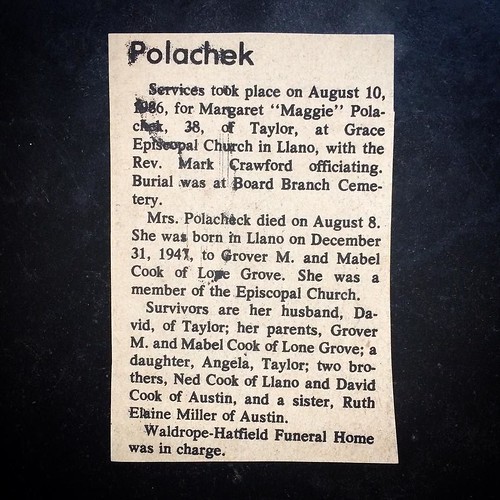
I found this the other day, in a stack of photos my aunt sent to me. This smudged little snippet – a whole life reduced to a few inches of newsprint, where they couldn’t even be bothered to spell our name right twice (it’s Polacheck). Obituaries are so very final – and usually, they say so very little. This pitiful scrap tells you nothing about my mother – nothing about her accomplishments, her struggles, her hopes or her dreams. Nothing about what she loved or hated, no words to even attempt to express what kind of person she was, or what kind of hole she left in the world, in our lives, when she died. It’s so stark, seeing my own name in an obituary. Seeing that number, 38. The facts are cold and hard, printed out in the newspaper for all to see. That was her life, right there. Ended. Trim it out with little scissors and save it in an envelope. That’s it.
So, a few months ago, it hit me for real – that my mom died at the age I am now. Which wasn’t very old after all, it turns out. It’s all relative. I remember when I turned 31, and well-meaning, naive 20-somethings telling me (with a hint of awe in their voices), “Wow, you totally don’t look that old at all!” It’s so hard to contemplate when you’re young, growing old, or dying. Another question mark, blank space. Death? When all you know is life, life, life – climbing trees and dripping popsicles and dancing until you get a stitch in your side and being bored and craving toys and attention and affection. Childhood feels like a blur of sticky hands and flailing limbs and the agony of having to sit still when you want to leap up and whirl around the room screaming wild at the top of your lungs. And then there was death. I started thinking about it, knowing about it, younger than most kids.
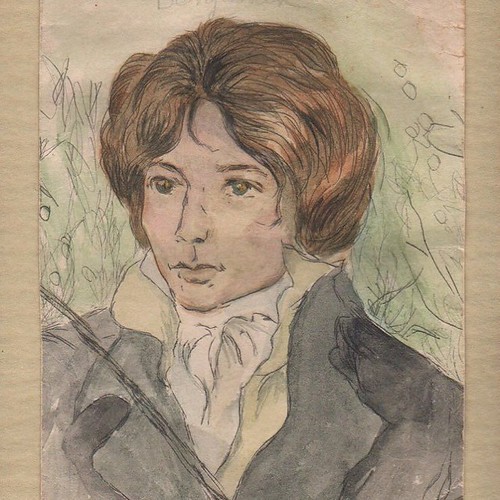
A watercolor my mother painted of her idol, John Keats
My dad and I have been talking about my mother’s infatuation with those poets, artists and musicians who died too young. For her, it was always John Keats and Hank Williams. My father told me this:
“She learned pretty much all there was to know on their lives and work. She acquired the complete published works of both men. Meeting Hank’s friends and relatives and visiting his gravesite was very important to her. Producing unique and lasting work of genius in a short unhappy life of pain and suffering, this was her obsession. It’s very Romantic, the doomed genius artist, largely under appreciated until he is gone.” She put her heart and soul into artworks commemorating her passion for both Keats and Hank, a collage series called “The Mansion of Many Apartments” and her portrait of the lonely cowboy called “Star-Crossed Troubadour”. She outlived them both, but only by about ten years. Dead before her time, and as Keats put it, “…half in love with easeful Death…” The phrase “dying into life” from one of Keats’ poems comes up a lot with my mom. I both understood and totally resented her fascination with dying young, and those who did. She became part of that club, the tragic geniuses hanging out in the graveyard, never growing old, becoming immortal, always remembered because of the great works they left behind. Maybe it’s because of this that I sometimes feel I have a desperate mission to shine a light on the works of those bright stars who died too young, without ever receiving the proper recognition. I wish everyone could know how goddamned talented my mom was. She never became famous, or legendary in her day – except to the people that knew and loved her. I think that’s the real way we achieve immortality, eternal life – is through the preserved memories of those who choose to remember us, and what we did here. I long for that for myself, which is most likely why I save everything I ever made – hoping to leave something for the biographers. It’s definitely fanciful and vain to think that way, but I can’t help it. It’s embarrassing to admit, but I still save everything for posterity, thinking that someone might want to pore over it in my archives one day, the way I do over my mother’s scraps and bits I’ve managed to preserve over the years. I examine these for clues, like a forensic archaeologist dusting bones, hoping they might tell me something more about her life, about her days on this earth. What will my stack of daily planners, my grocery and to-do lists tell someone who loved me, who misses me, about my time here? Will it help them, to look at these things? Or will all of this stuff end up in the recycling bin, or pawed over at an estate sale like the sad grabby debacles I used to frequent?
So, with all of this, it’s probably no accident that I became a goth around the age of 13 or so. A constant awareness of our own death makes us think about life differently. Thinking constantly about death, my own especially, became a theme for years, and is something I still struggle with. I can’t tell you how many times I’ve imagined my own funeral, in great detail – or envisioned quite explicitly, all the terrible ways I might meet my demise. For a long time, I felt a little ashamed of this morbid preoccupation – until I learned that it’s very common, especially for children who have experience loss at an early age. We seek to understand what has happened through the filter of our own existence, which is usually all little kids can generally relate to, anyway. That habit is still with me, but it’s shifted. I can’t help but contemplate my own mortality, given what I know about what’s possible – that we have no guarantee, no divine promise that we’ll all live to a ripe old age. I believe every one of us has a number, and when our number is called – it’s time to go. My mom’s number was 38. I don’t know mine, but it wasn’t 16 or 22 or 30 – miraculously, despite all the crazy, reckless situations I was putting myself into. Maybe my mother had something to do with that, too – protecting me from harm. I know I have guardian angels abounding – because there’s no way I’d be here otherwise. The presence of death changes you, makes you live like a fugitive, constantly looking over your shoulder, feeling like you’re living on borrowed time. Marked by your own mortality, the ace of spades flung onto your chest.
The number 38 has been a sword of Damocles hanging over me, the pendulum over the pit, ceaselessly swinging. When I went to Morocco last year, it was the dark voice hissing in my ear saying, “it’s now or never, my dear…” that made me take a deep breath and buy my plane ticket. What if I died, having never seen Africa? Could I be okay with that? The answer was no, I couldn’t. I went, I saw the Sahara (and so many other amazing things!), and I lived deeply in that experience. I’m headed to Oregon soon to witness my first total solar eclipse. The last one occurred the year I was born, 1979. The trip feels a bit stressful, fraught and complicated to plan – and there have been moments where I felt tempted to call it off and stay home to tend to my work and my dogs. I’ve been reminded that there will be another solar eclipse in 2024, with the path of totality falling right over where I live. But a lot can happen in 7 years. Will I be alive to see it? My mother’s death reminds me that I have no guarantee. I have to live each day as if it is my last – something I rarely succeed at (as a dither around my house, woolgathering and scrolling through silly stuff on the internet…) And so, to Oregon I go, praying for good weather and a powerful, potentially once in a lifetime experience.
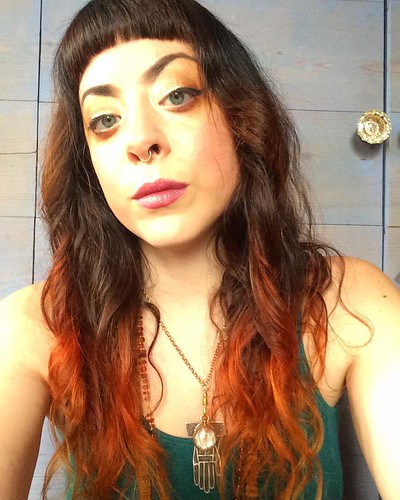
Virginia Woolf, who was thirteen when her mother died, wrote, “Youth and death shed a halo through which it is difficult to see a real face.”
― Hope Edelman, Motherless Daughters
Recently, I was at the pet store where I buy my wolf pack’s fancy expensive dog food, and I caught my reflection in the tinted glass doors. For the first time, I was startled by the resemblance between my mother and myself. I rarely see it, thinking I look more like my dad most of the time. It’s in the little things, though – the way we carry ourselves, the way my mouth and chin are shaped like hers, in repose. That day, in my wrap skirt and tank top, wearing big round sunglasses like the ones she favored, my hair in a ponytail – I could see it, I could see her, standing there in front of me. In so many ways, I realize that I am living my mother’s dream life: a life that she would have loved to have had for herself – living alone in a beautiful home created to my own specifications, free to go anywhere I want, whenever I want, doing work that is fulfilling for me, and surrounded by loving friends, family and many adoring critters. By living my life to the fullest, I honor her, and the loss of all the years she should have had to enjoy here. Some days, it feels like a lot of pressure – to honor all of her legacies. She left paintings and collages unfinished, memoirs unwritten. Her fiddle and guitar gather dust, go unplayed. I have taken up her jewelry making, silver-smithing – and created pieces from all the unfinished cabochons she left behind. Recently I was told by my aunt and dad both, on separate occasions, that I have surpassed her in skill. That my jewelry now is far beyond what she was able to do. That’s an intense thing to hear, and I feel both pride and shame in thinking about it. I can’t attribute it to talent, really – only the accident of time, that I’ve had more than she did, to learn my craft. I remember the trepidation I felt when I first began, feeling so nervous at my first jewelry class – what if I’m no good at this? What if I don’t like it? How will I honor her then? Who will finish what she wasn’t able to? I lay awake at night often feeling wild with anxiety about my inability to squeeze all my passions into every week, about all the languages I have yet to master, all the songs I wish I could play. In these dark and sleepless moments, I fervently curse people who complain of boredom – wishing I could steal their wasted hours to put to good use. I remember my mother always telling me, “Only boring people get bored”, whenever I would complain as a kid. I took this wisdom to heart, and try my hardest to never allow myself to get boring.
I feel very alive and very terrified when I go to the gynecologist to get a pap smear, when I got my first mammogram, recently – trying to breathe as the cold plastic squashed my breast. Preventative measures. I spit in a tube, took a test to check my genetic markers for cancer. The day all my results came back negative, it felt like the sun coming out from behind a cloud – on a day you were told would be stormy. Maybe I won’t die like that, then. Perhaps I can avoid her fate, and I’ll have some other kind of death. I’d prefer it being devoured by a wild beast, truly – to laying alone in a cold hospital room while my own body betrays me, killing me slowly from the inside out. I would rather have the gnash of teeth pulverizing my bones than the slow drip of chemotherapy. If I ever do get cancer, it would be so hard to trust that I could live through it, survive it – though I know now many people do. Many people don’t. I am trying my hardest to keep living my best life – to stay here in body, a place I refused to completely inhabit for a long time. I am learning to stay connected to my breath. When my mother was alive, all my energy was focused on wanting to please her, wanting her gaze to turn my way – wanting her to be a captivated with me as I was (and am) with her. People tell me that she would be so proud of me, proud of the life I’ve created for myself. I think that that’s true. I like to think so, I hope so. I am finding myself at the intersection where her life ended, and mine is truly beginning. I am more awake now, more content, more present than I ever was able to be when I was younger – and I am determined and completely committed to squeezing every last drop of ambrosia out of the time I have here in this human body, in this remarkable incarnation. I can’t imagine having to say goodbye to my life right now – so young, with so much undone. This year, her death anniversary feels extra heavy, and I’ve been really struggling under the weight of so much grief, and long-held fear. I’m trying to stay present, and keep sitting with this awareness, and the knowing that (if all goes well), I will outlive her – and go far beyond this train-stop where she had to disembark, her journey sharply truncated. I feel like I want to celebrate being alive – like I want to be held and shaken and danced around with to wake me up into the reality that I didn’t fucking die like she did, when she did – to acknowledge somehow that I’ve passed over the dreaded mark. Maybe every year after this will be even stranger. She never even made it to 40, which just feels so very young to me now.
For a long time, I had inherited my mother’s infatuation with the romantic idea of being a famous artist who died too early – but not anymore. I want to become an old ancient crone –crotchety, wise, and whiskered. My mother never got to grow old – and I will never get care for her or learn from the wisdom of her elder years. I feel robbed of so much. It’s been so hard to walk my road without her to guide me. I’m told she is, that she does – and I’m learning to trust in that. But it’s not the same, you know? I can’t imagine having to say goodbye to a seven year old daughter – which is maybe why she didn’t. It feels impossible, to accept that 38 years was all the life she got. How on earth does anyone accept that? If I died tomorrow, I’d know I lived a good life – that I worked hard, loved harder, saw the world, and experienced much bliss. But I’m not done here, and I won’t be – not for a long, long time… Rest In Peace, mama. I wish we’d had more time.
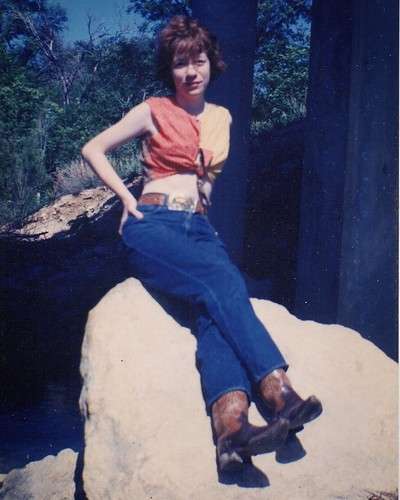
My mother, Maggie (Margaret Merrill Cook Polacheck – December 31st, 1947 – August 8th, 1986) This photo was taken when she was a teenager, only 16 or so, I believe.
If you’d like to read more about this journey of grieving, honoring, and remembering, here you go:
30 YEARS – SEIZURES
888
WILD BLUE YONDER
NO ROOM IN MY HEART FOR THE BLUES
FAMILY VACATION – HANK WILLIAMS’ GRAVE
STAR-CROSSED TROUBADOURS
Foxes in the Rain
Triumvirate Lemniscate
Gustav + Mama – August 8th
Matrescence
by angeliska on May 14, 2017
For as long as I can remember, I had always wanted to be a mother. I remember cradling my rosy plastic baby dolls lovingly, wiping their hard molded little faces, inhaling the powdery synthetic perfume of them, and feeling as sad when that special smell finally faded as a grown mother might when her baby no longer smells like milk. I have always loved children, and always instinctually knew how to nurture them – even as a very young child myself. Little kids have always been drawn to me. In supermarket lines, at the next table over in crowded cafes, the bright gaze of a baby or toddler will always seem to alight on me, staring until they catch my eye and I make the kinds of faces that reliably elicit squeals of delight. This gazing, the mirroring of facial expressions, the hours and hours that a mother can spend just making silly faces with their baby – I’m not totally sure that I got much of that when I was an infant. Maybe a part of me still needs it, and knows that some other children do, too.
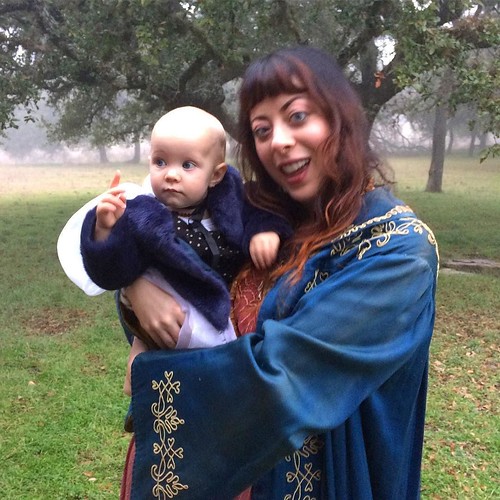
I am honored to serve as one of many amazing fairy godparents to this magical little elf child, Thea Beija. I look forward to seeing her grow, and having conversations and adventures with her throughout her life. She’s a wonder.
I acquired my first job, at age eleven – working with kids at a daycare. I was chief cat-herder, baby-wrangler, nose-wiper, shoe-tier, story-reader, make-believer, nonsense-babbler, peace-maker and tantrum-soother. I learned so much about patience, tolerance and multi-tasking during my years in child-care. Adults would ask me when I was younger if I thought I’d ever want children, but when I emphatically said yes, they would try and talk me out of it – saying I had no idea how hard it was, how thankless, how much work. I figured that after several summers of keeping a wild gaggle of little ones ranging from infancy to six years old happy and safe, I might have at least some idea of what it could be like, but then – I always got to give them back to their parents at the end of the day.
I used to throw big Easter parties, and invite all the children of my friends and relatives. I would always end up feeling like Mother Goose, with a train of little kids swarming around my skirts, tugging on my sleeve, coming to me for a game, a story, a band-aid and a kiss for their boo-boos. At parties and weddings, kids will cling on to me, wanting to stay with me, have me carry them around and dance, clamber on my lap and whisper in my ear, “I wish YOU were my mommy.” Many times, I’ve caught a child studying me thoughtfully for a long time before informing me that they couldn’t wait until I had children of my own, and telling me that I would be such a good mama. I guess you can’t ask for a better endorsement than that, right? Children know. I always say that if I am well regarded by children and dogs, then I can know that I’m doing all right as a human. I tend to care about their opinions more than anyone else’s.
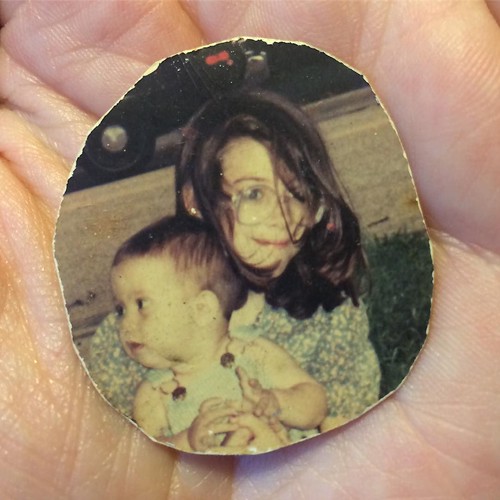
Big baby little mama
After my mother died and we moved here, my dad had to find someone who would take care of me in the long summers when school was out and he was working. He found a nice lady who took in little strays like me at a daycare she ran out of her house – the same one where I would eventually work, when I got too old to be babysat. The daycare lady had a baby girl with big brown eyes that crinkled up in the corners like her mother’s. I have a photograph of myself at seven or eight years old, eyes big and scared behind thick glasses, a little owl holding that huge baby on my skinny knees. I only realized this recently but – instead of clinging to the nice lady, the mommy – I clutched and clung to her baby. It was always this way: I knew how to nurture, but not how to be nurtured. That sort of thing felt alien, uncomfortable, wrong somehow. My aversion grew out of my fear, and this unfamiliarity. My own mama, before she died, I think maybe didn’t really know what to do with me. She was overwhelmed by motherhood, by this tiny yowling creature that intimidated and frustrated her. I needed so much. I’m only just now beginning to really acknowledge the layers of loss that are mine to work through, and truly understand where it all began: with a little thorny seed nestled in my heart, a spiky thistle that sprouted up from that dark place in me, a yearning maw that ached with this knowledge: that no mama could ever have enough love, enough patience, enough care to heal in me what I had lost, what I only ever halfway had.
Whenever other kids’ well-meaning mamas would see wee bitty me, a pitiful creature so obviously hungry for love, they would instinctively attempt to press me to their bosoms. It was all I could do not to hiss and run away, prickly little hedgehog that I was. They might try to embrace me, or say they wanted to try – but I was sure that eventually they would grow tired of trying to feed a baby whose belly was a bottomless bucket. I would get pushed off the lap at some point, surely. And that would be far, far worse than continuing to go it on my own. I knew without knowing something about that bonding that I never got with my mother. I thought I knew nothing about devotion. I was wrong.
My dad married an amazing woman a few years after my mom died, who wanted a little girl passionately. I didn’t know or understand it at the time, but we both could have filled each other’s empty spaces, if only I hadn’t been so afraid. I had no idea how to receive mother love. My wonderful step-mother persisted in trying to love on me and fill me up nonetheless, despite how difficult I could be. She has put up with and softened my rough edges over the years, and taught me much about unconditional love and generosity, now that I am ready to understand it – and I am eternally grateful to her, and to my dad both for seeing me through a very rocky adolescence (and beyond.) I have no idea who I would be without them, and I shudder to imagine.
Them that raised me. My father and my step-mother on their wedding day.
Them that made me. My father and my mother.
In the majority of the photographs from my childhood, my father is the one holding me, tying my shoes, feeding me, bathing me, changing my diaper, making silly faces at me. I have at least two or three out of all of those photos where my mother is the one holding me. Definitely two. You can say, well – maybe she was the one taking all the photos? Maybe so. But I think my grandmother was responsible for taking most of them, from what I can tell – that was always her gig. My dad has told me that he was the one who provided most of my emotional caretaking. He was then, and is now, an extremely devoted, patient, playful and loving father. But he was also saddled with being the provider for a family struggling with debt during the recession in the 1980’s. Both my parents had long commutes and worked crappy jobs for little pay.
I know they were both stressed and exhausted most of the time. I know that they both did their very best to parent me and raise me right, and in a multitude of ways, they really did an fantastic job. Maybe if my mom hadn’t gotten sick so soon, so fast and so hard, maybe we could have gotten through it, and connected the way we both really wanted to. But that’s not what happened. For most of my life, I thought the worst wound I had to carry was my mother’s death. It’s taken me a long time to realize that everything that happened before that contributed in so many ways to a lot of the deep patterns of anxious attachment I’ve been learning to work through in my relationships. It’s fascinating, how much what we experience before our memories even really form shapes us fundamentally.
My birth was a hard one, and it hurt my mother – it hurt us both in lots of ways. I think that blissful bonding, that skin-to-skin exchange of raw oxytocin love-drugs was something we never got to experience. My mother said she felt a sharp kick right before her water broke. It happened in the middle of the night, or very early morning. My father said that he went from the deep dead sleep to wide awake in the fraction of a second. He said they rushed her to the hospital always prevent infection and her labor was immediately induced with pitocin. She was given an epidural and episiotomy. I was transverse, flipped the wrong way, facing the wrong direction. The doctor reached in and turned me around to face properly to be born. Emerging from the mother water. My birth journey, interrupted. The newest I ever was. I came into this world drugged and afraid, because my mother was drugged and afraid. I reckon that they swooped me up and swabbed me down, snipped my cord and stifled my squalling. I was cleaned and weighed and measured and eventually, eventually brought back where I belonged with my mom but she was distraught, disoriented and confused. She thought that she had done something wrong. I think my mother was afraid of me. I was jaundiced, a yellow little thing, so I was whisked away to soak in an artificial sun from a bright lamp. Was this where I got lost? Perhaps this was the point at which my soul disassociated, fragmented, went floating off in space like a balloon. I didn’t feel safe, or loved, or wanted. I did not feel welcomed, or that I belonged here on this earth, in this body.
I think that’s how we missed each other, like ships in the night – in that frantic moment of interfering protocols. It’s as if we were two acrobats on the flying trapeze who missed our moment to grasp each other’s hands, to connect and be bonded for life. Instead, the moment sent us rushing past each other, and both our hearts went sprawling. Me, a little baby up there on the trapeze, swinging wild and alone. Her, crashing down to earth, to this new reality she was completely unprepared for. This is where it all began for me, that sense of being unloved, unworthy, unwelcome. My dad says that he believes he bonded with me in a way that she couldn’t. I know he did. In one the pictures my mother meticulously glued into my baby book, she seems truly blissed out, holding a naked little me on her lap angled towards her breast. I have pored over this photograph over and over, trying to feel a fragment of that lost bliss. I know from her letters that something went wrong during her labor, with the episiotomy, or maybe when they turned me. The doctor had done some damage, and for weeks after my birth, she was in horrible pain, and no one would listen to her, no one would believe her and treat the issue. I know that her physical pain, as well as most likely postpartum depression had something to do with what went awry with us, with her ability to be available and open to me, this terrifying tiny creature.
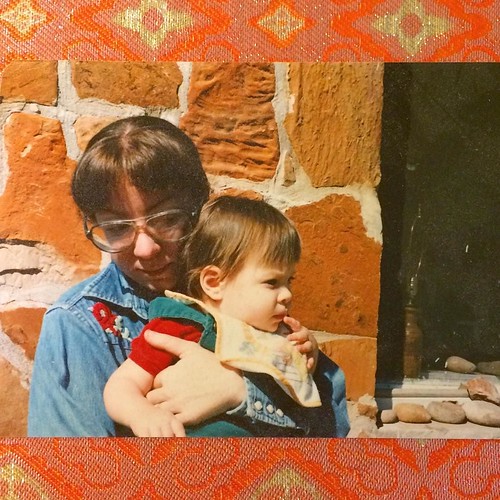
I was in the wilderness of Colombia a couple years back, staying at the remote maloka of an indigenous shaman, or taita. I was with my Uncle Don, who I am not related to, but who has known me all my life. He and my mother had been friends since they were toddlers, he was one of the first people besides my parents to see me after I was born, and he was at my mother’s bedside when she breathed her last. We were preparing to drink yage, or ayahuasca – a powerful plant medicine used by the tribal people of the Amazon for deep healing. I was sitting in a colorful hammock, feeling nervous about the ceremony to come when Don decided it was a good time to say, “Well, I made a promise that I’d never tell you this, but the truth is, your mom wasn’t too sure about the whole motherhood thing. It’s not that she didn’t love you – I believe she did, in her way… But she just hadn’t really realized what she was getting into. And she just wasn’t into it.”
I was rocked by his honesty, harsh and unexpected in that moment, but somehow necessary. It was a hard thing to hear, especially given where I was and what I was about to do. It was liberating to finally hear someone tell me the brutal truth, to confirm the deep dark secret I’d always instinctively suspected, but could never give voice to. What a terrible thing to admit, to say, to know. “I’m not sure my mother wanted me. Not really.” I used to think it was that she didn’t love me. I know now that she did, but I’m not sure that she knew how to. I don’t know if she really loved herself. Or knew how to. You can’t give what you don’t have. She was emotionally unavailable, or only intermittently available. She was preoccupied with her passions, and a little ambivalent about certain aspects of motherhood. I don’t fault her any of that, truthfully. It was the 1970’s and this was just what you were supposed to do – fulfill the fantasy of getting married and then pregnant, and then everything unfolding easily and seamlessly, just like it played out in the movies and storybooks.
My family on my mother’s side were not the touchy-feely, demonstrative, cuddly, always saying “I love you” kind of folks. They were honest and warm and loving, but they had their own more reserved ways of showing it. Little ones need touch, skin to skin contact, eye contact, closeness – in order to grow, to feel safe, to thrive. I know I didn’t get enough of that, and that it’s affected the way that I give and receive love. So much of the healing on myself I came to this earth to do centers from that place, that lack, that lacuna.
In 2005, I fell in love, and bought a house with a man I could really see spending the rest of my life with. He was gentle, kind and loving, and I felt that he would make an excellent father. We set about working on the house and garden, and building up our lives around a shared dream – until it all fell apart. We were engaged, planning our wedding, when the cracks began to show in our foundation. I found myself at 33, alone in the house I’d imagined by that time would be filled with children and laughter, the relationship over. I was so, so sure of how it was all going to work out: marriage, motherhood, a beautiful home – the whole sha-boom. When that ship sank, I was completely bereft. I absolutely could not imagine being happy without a partner and a child in my life – and yet somewhere in me, I knew that as long as my happiness was dependent on this dream being fulfilled, that I’d probably never have that, or be truly worthy of it. I knew I’d have to travel to the other side of that looming black mountain – where I could find happiness and fulfillment without a ring on my finger or a baby in my belly. Because I finally realized that those relationships can’t be about fulfilling some empty place in me – that’s not what love or parenthood is really about, at least not the healthier versions.
Parenthood is not about wanting a baby. Babies grow into people, and you have no idea who the hell they’re going to turn out to be. Probably not at all what you expected, or planned for. Because they are their own people. Parenthood is about wanting a baby, even a screaming, red-faced colicky baby, or a special needs baby, and it’s about actually really wanting an insufferable two year old you’re always having to chase around, and absolutely wanting to make a weird Halloween costume for that four year old person who will only tolerate wearing it for an hour, if that. It’s about wanting to sit at the table after eating spaghetti doing math homework. It’s about telling stories and explaining things and singing songs and helping someone go poop. Over and over and over, for many many years. Plus, later – having a bratty teenager who slams doors and breaks your heart and runs away and is embarrassed to be seen with you. It’s about giving everything you have and more to someone who will most likely throw it all back in your face one day and tell you they wish they were never born, or that they wish someone else was their mom. It’s about loving someone more than you ever thought possible and having to live constantly with the fear that something terrible might happen to them.
I remember a friend telling me that having a child is like suddenly having your heart live outside of your body. This wild little person running around like a maniac, jumping off things and later probably sneaking out of the house at night and driving too fast. Imagine loving a child more than your own life – and knowing that their body might betray them, their friends, their protectors, their society, their own hearts might betray them, might even kill them. I hear that it’s a full time job and the biggest responsibility anyone with ever have and that’s it’s completely exhausting and totally rewarding and ego-annihilating, life changing and heart-exploding. That’s what the parents I know tell me. I thought for a long time that I wanted all of those things. Some days I still do. Some days, not. And my time to experience that terrifying wonder grows shorter.
I have to ask myself honestly now: do I really, really still want to be a parent? The unpleasant reality is that I hardly ever visit my friends with children. I neglect the god-children I have, and never spend enough time with my nieces and nephews. My dogs definitely don’t get all the walks and attention they deserve (though they do have pretty wonderfully spoiled lives). It hit me one night as I sat hunched over my laptop, furiously writing something, (or trying to) with my dog Moon repeatedly putting her toys on my lap for me to throw, and looking at me expectantly, eagerly – like a little kid who craves interaction. “Mama? Mama? Play with me? Mama?” I realized that she was me, trying to distract my mom away from her art, her paintings – she was so driven to create, and had so much talent. My needs didn’t really fit comfortably into her need to make art.
I understand that now. It’s really fucking hard to do, and I respect all parents, especially mothers, that find a way to balance child-rearing with creating, or fulfilling dreams and ambitions. Or even just making a living and scraping by. That shit is a lot to juggle, and anyone who manages it deserves, well – a lot more than a gold medal. I think that as much as I hate to admit it, that I would probably neglect my child, in much the same way that I was neglected. Moon is staring at me intently with big bright eyes right this very moment, a moist and raggedy toy in her mouth. I have to take a moment to pause from my furious typing to throw it over my shoulder, hoping this will keep her busy until I can finish writing this piece and finally take her outside to play. This absolutely would not fly with a human child. I can say this from my own experience.
Mother’s Milk – from the Tantric Dakini Oracle. May we all be divinely nourished – today and always.
Oh, matrescence – the process of becoming a mother. I’ve mostly talked myself out of it, for the time being – and that sliver of a moment may be all I have left, really. If the right situation evolved, I’d reconsider. But that seems like such a long shot at this point. I don’t want to go it alone. I’d want help – and it wouldn’t even have to be the whole package, the love and the ring and all of that. It’s a lovely idea, but maybe not essential in the way I once deemed it to be. A few years ago, I had a very vivid dream about giving birth in a big red velvet draped bed under the full moon in a field attended by two milk white goats.
When I awoke from the dream, I put the call out into the world and to the universe in general (publicly, via social media, because that’s how we do now) that I was looking for someone who was ready to be a father. Not just a sperm donor, or a baby daddy, but a real papa who would wake up in the night and change diapers and croon lullabies and cook breakfasts and help with all the things of raising a small person. It wasn’t a requirement for this person to be partnered with me, romantically, anymore. I was open to finding a financially secure and super loving gay dad or queer couple with major dad-longings. I was ready to find a man who longs to be a father, but was maybe not in a traditional position to easily become one. I wanted someone who would want to be present, every step of the journey, from conception to college – someone who wouldn’t want to miss a second of it! My vision of co-parenting didn’t necessarily have to involve a romantic connection, which is why I was open to collaborating on creating and raising a human with a gay man or couple. Of course, I’d have loved to have had an adoring partner who really wanted and felt ready for a kid, but I didn’t feel I had the luxury of holding out for the whole package any longer.
I received quite a few inquiries about it, and even had a few serious conversations about moving forward, but nobody really clicked or quite fit the bill. As I moved forward with opening that possibility up to a different kind of partnership, and inviting in a potential co-parent, I was also working steadily on healing those heavy wounds I had carried for so long. I used to dream of having a baby all the time, for years and years. Often, the dreams took place in a sterile hospital where my baby was always taken away from me before we could bond. Everyone got to be with my baby except me. These dreams were very upsetting – but I had no idea at the time how closely they mirrored my own traumatic birth experience. Every time I dreamt of being pregnant or having a baby, I thought it was a message that I was meant to be a mother. Sometimes I’d struggle to take care of the baby (always a little girl, who resembled me.) I’d forget her somewhere, and discover her later guiltily, stashed in a drawer and forgotten.
I’m not sure why it took me so long to realize that the baby in the dreams was always me. The most recent baby dream I had was both mundane, and incredibly powerful. I was changing my baby’s diaper. Literally dealing with my own shit. Lovingly, patiently – no longer neglecting the baby within. When I started really doing this work of healing that lonely little infant, of deeply nurturing my own inner child, much of my intense hunger to be a mother faded away. I’ve been doing a lot of intensive self-mothering, which can look like a lot of things, from day to day – but mostly it’s doing trauma therapy with EMDR and Somatic Experiencing on my early childhood relational and attachment trauma with my mom. It’s also paying attention to myself, instead of ignoring my own needs to focus on others. Care and feeding, showing interest and delight, being as gentle and forgiving with myself as I would with a small child.
(marvelous artwork by Aitch)
What a marvel, to see in front of you a small being that you created in your own womb: eyelashes, a nose, the bones of a face that mirrors your own face. The miraculous melding of two strands of DNA that result in eventually being able to have conversations with a tiny stranger who is made partly of you. I used to stay up late at night and read accounts of women’s birth journeys in the blue glow from my phone, tears streaming down my cheeks at their stories of their labor, their fear and suffering, their gratitude and awe. I wanted all of that – so much. I wanted to be heavy bellied, waddling pregnant, heaving up to stand, sunk in my own biology. I wanted to breathe and pant and push and groan like an animal. I wanted to reach down to touch the crown of my child’s head emerging from my body. I wanted to bond with that baby and feed them from my breast and rock with them in the rocker and soothe and coo and sigh with them for a long, long time. I really did want all that, fervently, vehemently, desperately. But maybe I don’t need it like I thought I did. My life is full, and rich, and delicious. I have just enough solitude, and just enough time (more or less) for all the people I love in my life, and for all the things I want to do.
The idea of living out my days without a life partner and a child shockingly just doesn’t seem like the hideous tragedy it once did. I’m happy as things are. I might be really, really happy if those people, that love and that child, joined me on the road up ahead. I bet they’d have things to teach me: hard and beautiful and unexpected lessons, I am sure. I don’t know what surprises my path might be holding for me beyond this next bend – but I know that in taking good care of myself, and making my life feel as solid and whole and strong as possible, that I am laying the groundwork for the kinds of relationships I want – with friends, family, for a lover, and maybe even a little one. I’m learning to fill up my own cup, so that I actually have something to give, if the opportunity ever arises. Because that kind of love was never meant to be about blind need, or filling a void in me, or giving someone else all the love that I didn’t get enough of. I know now that those are the wrong reasons.
Being a parent and a partner isn’t really about me. It’s about showing up and being completely present and ready to discover who those mysterious loves are, and learn what they might come to share with me. I have stacks of children’s books I’ve long collected that I’d love to read out loud someday, but I’m pretty sure that even if I don’t make or adopt a kid of my own, I’ll find someone who wants to hear them, if I just go looking. In the meantime, I can read them to myself, share them with that part of myself that delights in the illustrations, in the stories, in my own attention. I know now how to offer some love to that inner child who felt lonely for so long, and who finally, finally, knows she is home. I know now completely that I am loved, wanted, and welcomed. I know that I belong here, and I intend to stay in this body, on this earth, for as long as I’m allowed. I’m working on nurturing myself, my family and friends, and my beloved animals. And I’m going to keep on trusting that all that can be enough, more than enough.
Happy Mother’s Day to all the mamas, all the would-be mamas, the wishful ones, the heartbroken ones, to the women who have lost babies, or were never able to conceive, to the mamas I know whose children have died, or are estranged from them, for the children I know whose mamas have died, or are estranged from them – for all the love and all the loss and all the healing – to all of your hearts from mine.
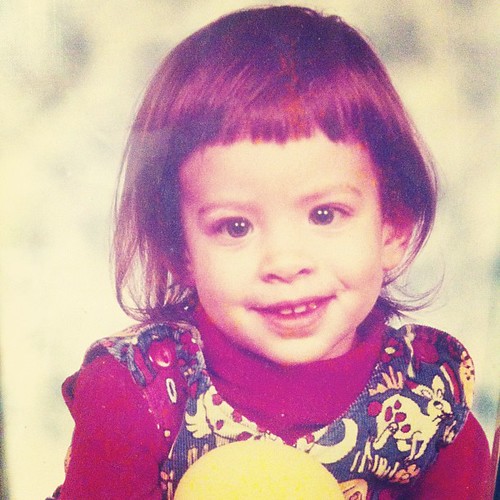
This Bitter Earth – Vernal Equinox
by angeliska on March 22, 2017
The Vernal Equinox heralds Persephone’s return into the light, beckoning her back up to the land of the living. Coming back slowly into consciousness – the body wakes up, remembers how to breathe, sigh, sing again. This Pluto transit I’ve been going through will keep me in the underworld for at least another year, I think – learning how to read the roots, speak to ghosts, be transformed completely. I’m not the same girl that was plunged down into the choking dirt a season ago. Persephone left the earth a girl, but walked back in the door of her childhood home, something else entirely. The deep want and longing that had always been a part of me have been purged from my heart, finally. I do not want what I haven’t got. I sang that song in a wavering voice under a full moon by firelight in the middle of the Sahara Desert. I am certain no one enjoyed hearing it, but I had to sing it anyway – because though I’ve sung those words for years, they’ve never been more true. I am walking in the desert. I am not scared, but it’s hot. I send a would be lover away from my bed, turn away from his kisses, even though he is the King of the Berbers. I am loyal only to myself, for once. I sleep alone, draped in his robes, his silk burnoose, pale blue. I am stronger than I knew, calm in my resolve, finding a truth deep in myself, way out in the middle of nowhere.

Today is a day for telling things, for whispering truths into the shifting sands. In a room full of women, we shared our secrets, telling each other’s – faces hot with the releasing, letting it all go. This is where all the deep work is happening. I see it all around me, in so many of the brave people I meet. Facing their shadows head on. We take care of each other’s darkest secrets, confessions scrawled on notecards and passed around the room, spoken aloud, clouds of shame dispelling, like puff-ball mushrooms deflating colored smoke, releasing gasps of relief. These truths hang in the air over our heads and then fade, just a ghost of something that had so much power, unspoken, untold. The shock and boom of fireworks exploding cathartically, and then just as suddenly turned to ash, to a floating jellyfish chrysanthemum made of haze. Was it ever real, this fear that held so much power over us? Sometimes. Thinking about the lost maidens we were, and the troubled young women in our own lives now – how hard it is to be female in this fucked up world. Thinking about all the mothers and daughters. How we lose and find each other, again and again and again. Stories of trauma and loss, memories of our teenage shames, and secret desires. Our bodies, ourselves. Mothers and daughters, lovers and others. Seeing so clearly now how I’ve been repeating that old story, for so many years now. I don’t need to do that anymore. The old sorrow is with me, but I know what to do now to be mother to myself, to give myself back what I lost, as best I can. It takes a lot of work, a lot of care. It’s worth it. I cry for the girl I was, how much she had to figure out on her own. I’ve been thinking about that time in my life a lot lately. Going into the past, sitting with how far I’ve come, how much my life, and my perception of it has changed. What has remained. I have lost so, so much. But everything I’ve gained has more value to me than robes of silver, than a starry crown. Worth more to me than a gold ring on my finger. Knowledge, peace, and freedom – more precious to me than any of those old illusions I once clung to so fervently. It’s some deep Venus in Retrograde work, Our Lady Underground. My fingers feeling around for the shape of her, eyes unseeing. Digging the carved stone figure of a goddess out of the ancient dirt. Scrabbling blindly for the sacred. Have you ever been inside a cavern, deep under the earth, when the tour guide shuts all the lights off? Letting your vision adjust to that complete darkness, total lack of light. I always wish they’d let us stay in the dark for just a little while longer. It’s such rarity, that level of deep pitch black. Just like seeds, we need it to grow.
The only legend I have ever loved is
the story of a daughter lost in hell.
And found and rescued there.
Love and blackmail are the gist of it.
Ceres and Persephone the names.
And the best thing about the legend is
I can enter it anywhere. And have.
As a child in exile in
a city of fogs and strange consonants,
I read it first and at first I was
an exiled child in the crackling dusk of
the underworld, the stars blighted. Later
I walked out in a summer twilight
searching for my daughter at bed-time.
When she came running I was ready
to make any bargain to keep her.
I carried her back past whitebeams
and wasps and honey-scented buddleias.
But I was Ceres then and I knew
winter was in store for every leaf
on every tree on that road.
Eavan Boland
– an excerpt from The Pomegranate

The Rape of Persephone – Rupert Bunny
I’ve been in cold storage, like a bulb tricked into thinking it’s winter still. An unripe pomegranate. The soil frozen, down deep. Permafrost. I’ve been sweating since December, a hot Christmas, celebrating the New Year with bare arms and legs. The rest of me never thawed, though. I dig in my long shovel, muddy boots shoving it in deeper, ripping the old roots out like rotten teeth. I never planted this, never wanted this – and now it’s taking over, invasive. Sea-Oats. I’ll leave a small patch, because the dangling seed-pods are good in bouquets – but this is my garden now. Mine, and mine alone. I reclaim my body that way, all the places the old lovers like ghosts used to touch, mine and mine alone now. Never theirs again. Broken trust, and deep violation. The old story, Proserpine’s abduction. Old myths. Ancients gods and goddesses rear up enormous, fantastical, breathing fire, trampling cities like juggernauts. Terrible and beautiful (but mostly terrible.) My arms held behind my back, pinning me down, face in the dirt, mouth full of dead leaves. A voice in my head, a dark memory saying, “I own you completely. I fucking own you.” No, you don’t. Not anymore. No longer ill-used, kept in a back pocket for safe-keeping, possessed. Robbed of my choice. Kept in the dark, intentionally. These are Plutonian lessons: sex and death, love and loss. Control and liberation. I suppose I could not have truly learned any other way. But goddamn. I told a shorthand version of this myth to a beautiful maiden on a dark night, on the road back from New Orleans. Winding through the bayou. Telling the tale of the underworld descent, as we made our way back up from below sea-level. Why did Persephone eat that pomegranate, anyway? In doing so, she sealed her fate – to become Queen of the Land of the Dead. This is the other aspect of myself I’ve been learning to embrace – the Mediumatrix. Learning that language, reading the letters written on the cave walls, inscribed on tombstones. Maman Brigitte, whose domain is the cemetery. My mama didn’t name me that for nothing, you know? So, I have to trust. However, I had been warned: don’t feed the shades! A bad spirit followed her home through the streets, tried to play pranks on me. I wasn’t having it. Performing the necessary banishing, cord-cuttings. The lit candle, out. In dark dreams, dead hands on me cold as clay, heavy as stone. Sleep paralysis keeps me from hollering at them – get off, get out! Go now, back to your grave, you old ghosts! It’s time for you to dissolve, fade into memory, dust. New sprouts are forming beneath the soil, lifting tiny green leaves into the morning sun. Spring is here, the birds are singing – wake up, wake up from your strange dreams! I don’t know if I know how or even want to write about how angry I’ve been. How hurt. Pluto has brought me harsh lessons, and I’ve had to work hard not to let my bitter tears salt the earth, make it so that nothing grows there anymore. I want good things to grow here, wild and strong. Truths, and wisdom. Joy and acceptance. Bit by bit I make my way there. Spring does not arrive overnight. There are still trees with bare branches. I’m giving myself a lot of time.
Pluto + Persephone – Edmund Dulac
I forgot my razor in New Orleans, and so have been experimenting for the very first time with letting the hair on my body grow – seeing what it does when left untended. I started shaving more or less as soon as my body first began to grow hairy, so I’ve never really seen it do its thing. I’ve been thinking about something my friend said, when she stopped shaving recently: that she would grow her body hair out until she could look at it without repulsion, until she could see it as normal – as beautiful. As part of her. Because it is. Growing wild, a thick tangle like roots exposed to the light. It was such a shock, when I was a young girl – the dark wiry hair standing out like a shock on such pale skin. Now, it seems so benign, so harmless. It’s surprisingly sparse, finer than I imagined. So much less hideous. Delilah taking back her own power, owning her animus. I am a mammal, after all – an animal. Perhaps it’s a protection, an amulet, personal talisman. In the underarm cavern, furring down shins, new sprouts, surprises. Growing wild. Feeling strong, a feminine strength. The scent of my own skin, intoxicating. I smell like a woman, like Artemis the huntress, with her loyal hounds, chasing only the moon. Musk and jasmine and leather. Carnations and goat-fur and candlewax. Transformations, explorations of identities, a deeper understanding of my own femininity. A strange and sometimes wonderful construct. An idea, an energy. I was granted new dresses for the first day of spring, flowered sprigs, pin tucked, gathered up and nipped in at the waist. I chose new ones, with room to let my belly breathe, in shades like ripe fruit and shadow: plum, cerise, soot. I hadn’t been wearing any of my more girly frocks much for a bit, or anything flowery or delicate anymore. I felt most comfortable in sort of shapeless overalls, dusk colored, warrior woman garb. Nothing to prove, no one to tempt. No need to be coy or coquettetish. I’m not looking to draw anyone into my orbit. All my lacy stockings are rolled up in their bundles in my drawer, unworn. Gowns hang in the closet like shed skins, high heels gathering dust. I’ve been unwilling to wear any constricting bullshit whatsoever, for the most part. A different mode for me. As is learning to be a good friend to myself, a loving and constant companion. To let myself unfold how I will, over this process. It’s been interesting, liberating, and curious. I am so much more comfortable in my skin than I have ever been. It is only from this place of acceptance and compassion can I initiate any real changes. I want to be stronger, I want to be healthier. So I’m working on that.
Demeter Mourning for Persephone – Evelyn de Morgan
i made it up
here on this bridge between
starshine and clay,
my one hand holding tight
my other hand
an excerpt from
won’t you celebrate with me
Lucille Clifton, 1936 – 2010
Mother and Daughter – Meinrad Craighead
We lay in the meadow, among evening primroses nodding their heavy petals, polled loaded. Buttery kissed noses, glowing in the gloaming. All the colors returning to the world that so recently seemed to be nothing but grey. We went down to the river for the parade in darkness, and looked around in amazement as the sun rose over the water and all the hues that had been leached away and hidden in the night were slowly revealed, brightening and deepening in intensity as dawn opened up her golden hands to embrace us. Our eyes were dazzled, our lips speechless, seeing each other, all of us – truly for the first time. Come out, come out – wherever you are! Scattering seeds: bluebells and scarlet flax, poppies and alyssum, bachelor’s buttons, delphinium, black larkspur and hollyhocks. I pull up the beggar’s lice, wild geranium, old cleavers. I plant Angel’s Trumpets. With whispered words I encourage horseherb, toadflax, frogfruit, spiderwort, henbit to reclaiming the garden. The wild weeds return to teach me their often overlooked and misunderstood magic
Demeter + Persephone – Susan Seddon-Boulet
look at love
how it tangles
with the one fallen in love
look at spirit
how it fuses with earth
giving it new life
why are you so busy
with this or that or good or bad
pay attention to how things blend
why talk about all
the known and the unknown
see how the unknown merges into the known
why think separately
of this life and the next
when one is born from the last
look at your heart and tongue
one feels but deaf and dumb
the other speaks in words and signs
look at water and fire
earth and wind
enemies and friends all at once
the wolf and the lamb
the lion and the deer
far away yet together
look at the unity of this
spring and winter
manifested in the equinox
you too must mingle my friends
since the earth and the sky
are mingled just for you and me
be like sugarcane
sweet yet silent
don’t get mixed up with bitter words
my beloved grows right out of my own heart
how much more union can there be
Untitled [“Look at love”] by Jalal ad-Din Muhammad Rumi
The Rape of Persephone – Simone Pignoni
Derek Walcott, a Mighty Poet, Has Died
I grieve for and honor this man who gave us this poem, that has helped me maybe more than any other, survive and understand the past five years. I’ve shared it before, but feel moved to do so again, because this lesson and practice is continuing to unfold for me, deeper than ever.
The time will come
when,
with elation
you will greet yourself arriving
at your own door, in your own mirror
and each will smile at the other’s welcome,
and say, sit here. Eat.
You will love again the stranger who was your self.
Give wine. Give bread.
Give back your heart
to itself,
to the stranger who has loved you
all your life, whom you ignored
for another,
who knows you by heart.
Take down the love letters from the bookshelf,
the photographs, the desperate notes,
peel your own image from the mirror.
Sit. Feast on your life.
– Love After Love
Derek Walcott

Earth
Let the day grow on you upward
through your feet,
the vegetal knuckles,
to your knees of stone,
until by evening you are a black tree;
feel, with evening,
the swifts thicken your hair,
the new moon rising out of your forehead,
and the moonlit veins of silver
running from your armpits
like rivulets under white leaves.
Sleep, as ants
cross over your eyelids.
You have never possessed anything
as deeply as this.
This is all you have owned
from the first outcry
through forever;
you can never be dispossessed.
– Derek Walcott
(from Sea Grapes)
Dinah Washington – This Bitter Earth
My theme song for this Spring: This Bitter Earth, recorded by Gene Chandler in one spectacular take.
Dinah Washington’s original slays me to the bone, but I listen to this one when I’m all out of tears…
This bitter earth
Well, what a fruit it bears
What good is love
Mmh, that no one shares?
And if my life is like the dust
Ooh, that hides the glow of a rose
What good am I?
Heaven only knows
Oh, this bitter earth
Yes, can it be so cold?
Today you’re young
Too soon you’re old
But while a voice
Within me cries
I’m sure someone
May answer my call
And this bitter earth, ooh
May not, oh be so bitter after all
Equinox wishes from days of yore:
Fallings, Turnings – AUTUMNAL EQUINOX
AUTUMN HERALDS
Fruit + Flower
Tiempo de la abeja y la flor
FOLDEROL, FALL AND ALL
EQUINOX SONG
THE COLOR OF POMEGRANATES
Pomegranate Star Ritual for The Winter Solstice
ARMOR/ARDOR – Full Moon in Cancer
by angeliska on January 12, 2017
Tonight is the first full moon of 2017 – a warm and unseasonably balmy night, even for January in Texas. I don’t really feel like writing, at least not much here – but I do feel like sharing, just a little bit, the ephemeral bits of words and images that are speaking to me in this moment. Marking the beginnings of things, and the endings of others.
I sit at my kitchen table with the window open, a candle burning, blessed with dried hawthorn blossoms my sister-friend gave me for my birthday. Wearing the little medal strung on thread with an aventurine bead she also gifted: “Our Lady of Prompt Succor, pray for us.” Both aventurine and hawthorn aid in heart-healing.
An ambulance goes by, my white wolf-dog friend Snowy howls from across the street. Full Wolf Moon, tonight is. The air smells lakey, a stagnant huff that rises up from the banks of the river some nights. I’m surrounded by vases of birthday flowers that also perhaps need their water changed. Hothouse blooms and standing water.
I sit, and write, and savor my solitude. Licking my wounds. Any kind of romantic love feels completely shut down for me now, in so many ways. I’ve gone dormant again. Hibernation, a stasis – gestating something hidden deep within, all that is my own. A seed pod, dried up and put away in a dark drawer. The shell around the tender sprout. Exoskeleton, armor, carapace, thorny encasement. Waiting for another season to burst open, when the ground is less hard and cold.
A moon opposition Saturn transit, bringing betrayal, heartbreak, alienation. Learning how to care for myself in the midst of all that mess. When I remember love, being touched in that way, my eyes clench shut, wanting to block it away. The memories searing, cauterized, scarred over.
Today, receiving a massage: unfamiliar warm hands on my stomach, my hips. There are pale scars there, faded: three, over my one ovary and the ghost of the other, and bisecting my navel. Not very many people have ever seen them. There was someone who once knew them very well. It had been a long time since anyone else really touched me there, with calm intention. I froze up, my feet wiggling to dispel the tension like little crab legs, pincers waving. An armored bodice over my soft underbelly. Breathing to relax, to receive touch again where it’s safe. Trying to heal heal heal. Full moon in Cancer lessons.
I don’t have the open-hearted trust that I used to. Loyal like a dog, smiling and panting and returning over and over again no matter how badly treated. Until now. One day the walls will come down again, for someone worthy, someone brave and determined enough to push through, find the treasure on the other side. Perhaps. Or, if not – it just doesn’t feel like such a tragedy any longer.
Until then, battalions and pennants waving, lioness rampant, protective, guarding the secret garden and the fountain at the heart of the fortress, the castle, my body a forbidden palace. In turns guarded and totally vulnerable – the moat around me, the briars that have tangled up sharp and thick. I can be happy here. Fresh water pushes up through the cracks, flowing again, chasing away the stagnancy, the pointlessness.
Intimacy and self-protection are incompatible, I know this – but for now, I rekindle that with my friends, with my family, with myself. I had a very beautiful and peaceful birthday, and I am extremely grateful for all the good and loyal love in my life.
It feels like enough, more than enough. I don’t need the way I used to. I know how to give to myself, fill up my own cup. Nurturing moon, teaching me how to make a home in myself, nourish my own heart. Tonight, with books and peacock socks and quiet and this sacred Thursday I will give to myself to write and write and write from now on to come back to my own garden, rake up the leaves, sit quietly by the fountain, and plant seeds for spring coming. I’ve come to hate winter – loathing the sight of bare dun trees and everything brown and sad. I know even though the air feels like April there is much to be done in this season, and so I’m trying my best to honor it. This is what I’ve got to share.
A little dish of moonlight and maundering from my table.
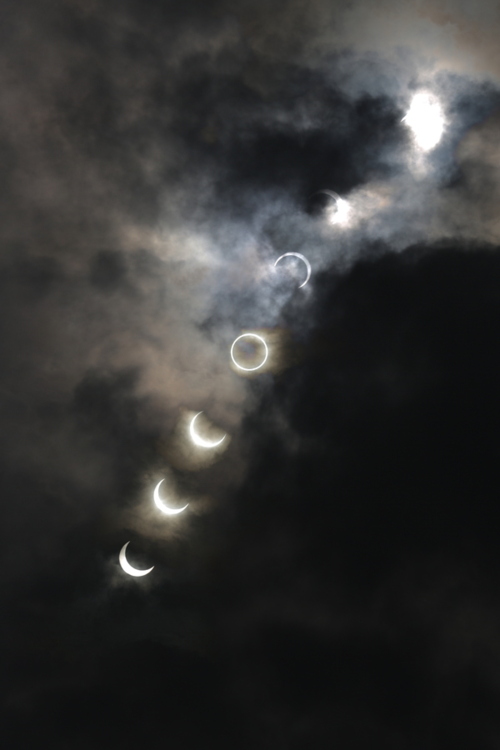
I receive a poem a day in my inbox, and the one that came to me on my birthday feels like the most perfect gift. Right before I opened it on my birthday morning, I thought, “Wouldn’t it be wonderful if this poem spoke to me especially, like it was written to my heart, and exactly where I am at right now?” And then so it was:
This City
by Eugenia Leigh
could use more seraphs.
Anything with wings, really—
a falcon, a swallowtail.
Ravenous for marvels, I slit open
a chrysalis. Inside,
no caterpillar mid-morph.
Only its ghost in a horror of cells.
I pinch the luminous mash
of imaginal discs
and shudder, imagining
the mechanics of disintegration.
The wormy larva—whole,
then whorled. A wonder
it did not die. Even now,
smeared against my skin, it beams
like the angel in the tomb
prepared to proclaim a rising.
Photograph by Marc Steinmetz – SAMPLE CASE
Assorted glass eyes made by
ocularist Alfred Greiner and his
father Arnold are used as models
to determine the individual
shape a glass eye must have to
match a patient’s eye hollow.
I’m reading Enchantments – A novel of Rasputin’s daughter and the Romanovs, by Kathryn Harrison who wrote one of my old favorites, Poison. I’ve always been obsessed with Rasputin and the Romanovs, so I’m enjoying delving into this story. The first paragraph struck me, stuck with me, thorny in my chest, remembering that feeling:
The Hole in the Ice
Behold: in the beginning there was everything, just as there is now. The giant slap of a thunderclap and, bang, it’s raining talking snakes.
A greater light to rule the day, a lesser light to rule the night, swarming water and restless air. A man goes down on two knees, a woman opens her thighs, and both hold their breath to listen.
Full Moon In Cancer – Tin Can Forest
Ellen Harding Baker. Solar System Quilt. 1876

Morning Star by Jeff Simpson


Silent Dying by Laura Makabreksu
Iron corset, 16th century, Museo Stibbert, Florence
My friend Olivia Pepper shared a poem from her friend Anis Mojgani recently. The whole piece is incredible, but this section I’m excerpting got deep under my skin:
Translation
3.
Inside the forest inside of me
is a house with a man inside of it.
There are other houses throughout the forest,
which once housed neighbors
neighboring the home of the man.
But they have all moved away
and the man is surrounded
by all these empty houses.
One day a woman moves into one.
She just shows up.
She sends a bird from her window to his, carrying a river stone in its feet.
He sends the bird back with a polished acorn. They send gifts back and forth
until one day she comes over to introduce herself.
They talk and laugh.
She goes back to the house she stays in.
A day or two later she comes back
and again a day or two after that.
Soon they are together every day.
Soon they sing together and cook together
and walk through the woods together.
Soon she stops going home to her house.
They sleep in the same bed.
He paints pictures of her where she has red hair
because he has red paint and she sits still
with a smile like she is watching a secret
form before her. She undresses and he moves
the wet brush across her back.
She sits quietly reading on his couch holding
her ankle in her right hand and then
holding her right hand around his left
Soon it is her couch too.
She has trouble falling asleep,
she kicks her legs restlessly.
He has trouble staying asleep,
waking up gasping for air.
Their arms find each other. The owls circle
silently. One day she is gone.
And once more it is just the man in the middle
of this forest of abandoned houses.
He sits with a stack of firewood and matches,
wondering which houses
are worth burning to the ground,
wondering if any of them are, and if so,
if his house should also burn.
by Anis Mojgani

All images here are credited where provenance could be found and credit given. If you know the source of an image I failed to find, I’d be grateful for the proper information – thank you.
Helpful insights from Aepril’s Astrology/Tarot Jan 13-19. Energy push-pull.
Happy full moon, lovers. Take care of your hearts.
Many moons of yore:
☾ UP FROM THE DEPTHS – New Moon in Pisces Eclipse
☾ 11.11.15. – NEW MOON IN SCORPIO
☾ Solstice Sisters – New Moon in Capricorn
☾ Wisewoman Honey – New Moon
☾ FULL SNOW MOON – SORROW AND KINDNESS
☾ Cold Winter Moon, Solstice Blue
☾ Summer Solstice – Strawberry Rose Moon
☾ FULL MOON IN SCORPIO
☾ Full Moon in Capricorn
☾ Flammarion’s Firmament
☾ Winter Solstice – Blood Moon
☾ Blue Moon Honey